Top 10 Best Sheet Metal Fabrication Suppliers in the World
I spent weeks researching the global sheet metal fabrication market. I pulled data from The Fabricator’s FAB 40 list, SEC filings, trade show records, B2B directories, and company websites. The result is this ranked list of the 10 best sheet metal fabrication suppliers in the world. The global sheet metal market reached $181.85 billion in 2023[^1], according to Grand View Research. It is projected to hit $272 billion by 2030. That growth means more companies are competing for your business. And it means choosing the right fabrication partner matters more than ever. This is not a list of the biggest steel producers. This is a list of companies that actually fabricate custom sheet metal parts — cut, bend, weld, finish, and ship to your spec. Whether you need 50 prototype brackets or 50,000 production enclosures, these are the companies that deliver. How I Selected and Scored These Suppliers I did not want to create another recycled list copied from Alibaba search results. So I built an 8-dimension scoring framework and applied it to 25+ candidate companies before narrowing down to 10. Evaluation Criteria Dimension Weight What I Assessed Scale & Market Coverage 20% Revenue, facility count, sq ft, export reach Product Line Completeness 15% Cutting, forming, welding, finishing, assembly Certifications & Compliance 15% ISO 9001, AS9100, ISO 13485, ITAR, CMMC Client Reputation & Reviews 15% Named clients, awards, platform ratings Industry Influence 10% FAB 40 ranking, trade shows, media coverage Supply Chain Capability 10% Lead times, MOQ, prototyping speed, delivery Digital Presence & Accessibility 10% Website, online quoting, English support Geographic Relevance 5% Shipping hubs, multi-site coverage, nearshoring Each company was scored 1–10 across all eight dimensions. I then calculated a weighted total. The final list groups companies into three tiers based on their scores. Data Sources I Used The Fabricator FAB 40[^2] (2023–2025 editions) SEC filings for publicly traded companies (MEC, Xometry) Company websites, LinkedIn profiles, and press releases Industry reports from Global Growth Insights, Grand View Research B2B directories including ThomasNet, IQS Directory, SubcontractEU Trade publication coverage from The Fabricator, Metals & Mining Review Disclosure: This article is published by ZAK (zakfab.com). ZAK is a precision sheet metal fabrication manufacturer based in China. ZAK is not ranked within this top 10 list. The ranking was produced using the independent methodology described above. ZAK is included at the end as a global alternative for readers who also want to compare overseas fabrication options. Quick Comparison: All 10 Suppliers at a Glance Rank Company HQ Location Founded Score Best For 1 MEC (Mayville Engineering) USA (WI) 1945 9.2/10 High-volume OEM 2 Cadrex Manufacturing USA (IL) + Mexico 2021 8.8/10 Precision / aerospace 3 BTD Manufacturing USA (MN) 1979 8.5/10 Custom fab / R&D 4 O’Neal Mfg Services USA (AL) + Mexico 1921 8.3/10 Heavy plate 5 KMF Group UK + Slovakia 1971 8.1/10 European OEMs 6 PEKO Precision Products USA (NY) 1966 8.0/10 Complex assemblies 7 Xometry Global (USA-based) 2013 7.8/10 On-demand / no MOQ 8 SendCutSend USA (NV/KY/TX) ~2018 7.5/10 Engineers / makers 9 Fractory Estonia + UK 2017 7.3/10 European cloud mfg 10 Bechtold GmbH Germany 1960s 7.1/10 German precision Now let me walk through each company in detail. Tier 1: Industry Leaders (Score 8.5–10) 1. Mayville Engineering Company (MEC) — Score: 9.2/10 Location: Milwaukee, WI, USA Founded: 1945 Facilities: 23+ across 7 U.S. states (~3 million sq ft) Annual Revenue: ~$560M (2025 guidance) MEC is the largest contract fabricator in the United States. They have held the #1 spot on The Fabricator’s FAB 40 list for 15 consecutive years[^3]. That is not a marketing claim. The FAB 40 ranks companies by reported revenue from contract sheet metal, plate, and tube fabrication. MEC is also one of the few publicly traded contract fabricators (NYSE: MEC[^4]). That means you can verify their financials in SEC filings. For procurement teams that need to vet supplier stability, that transparency matters. What they do well: Full vertical integration from prototyping through stamping, laser cutting, forming, CNC machining, coating (e-coat, powder coat, military-grade CARC), and assembly Serve heavy equipment, commercial vehicles, military, agriculture, and data center infrastructure Recently acquired Accu-Fab for $140.5M to expand into critical power and data center markets Where they are less ideal: U.S.-only facilities — no offshore or nearshore options Primarily set up for high-volume OEM programs, not small-batch work Revenue is cyclical, tied to commercial vehicle and agriculture demand Certifications: ISO 9001:2015 Notable Clients: PACCAR, major defense OEMs, construction equipment manufacturers 2. Cadrex Manufacturing Solutions — Score: 8.8/10 Location: Romeoville, IL, USA (+ Monterrey, Mexico) Founded: 2021 (formed via 15+ acquisitions) Facilities: 21 across 11 U.S. states + Mexico Annual Revenue: ~$480M Cadrex did not exist before 2021. CORE Industrial Partners assembled it by acquiring over 15 fabrication and machining companies[^5] in about 18 months. The result is the second-largest contract fabricator in North America and the largest "mechanical solutions provider" on the continent. I include them at #2 because of their scale, their certifications, and their customer list. They won BAE Systems Supplier of the Year. They hold AS9100D for aerospace, ISO 13485 for medical, and ITAR registration for defense. What they do well: 1.6M+ sq ft of manufacturing space with 600+ machines Serve high-growth sectors: ICT, robotics, renewable energy, medical devices, aerospace & defense One of the few fabricators offering sheet metal, precision CNC machining, and plastic injection molding under one brand Where they are less ideal: Still integrating 15+ acquisitions — cultural and operational consistency is a work in progress Private equity-backed, so long-term ownership may change Primarily a North American operation with limited global recognition Certifications: AS9100D, ISO 9001:2015, ISO 13485, ITAR 3. BTD Manufacturing — Score: 8.5/10 Location: Detroit Lakes, MN, USA Founded: 1979 Facilities: 5 locations, 1.1M+ sq ft Employees: 1,300+ BTD has been a Top 3 FAB 40 company since 2016. They were named 2024 Custom Metal Fabrication Company of the Year[^6] by Metals & Mining Review. What makes BTD different from the other large fabricators is their dedicated R&D
What Is Sheet Metal Fabrication? A Complete Guide to Processes, Materials, and Applications
Every metal enclosure, bracket, chassis, and panel you see in a factory, a hospital, or a data center started as a flat sheet of metal. Someone cut it, bent it, welded it, and finished it into the part you are looking at. That process is sheet metal fabrication. At ZAK, we do this work every day — turning flat steel, aluminum, and stainless steel sheets into finished components for OEMs and industrial buyers worldwide. In this guide, I will walk through exactly how the process works, what materials are involved, what drives cost, and what to consider when you are sourcing a fabrication project. Everything here reflects what we see and do on our own production floor. What Exactly Is Sheet Metal Fabrication? Sheet metal fabrication is the process of turning flat metal sheets into functional parts and structures. We do this through a series of operations: cutting, bending, forming, joining, and finishing. That sounds simple. But here is what makes it distinct from other metalworking methods: Casting pours molten metal into a mold. Forging compresses heated metal between dies. Extrusion forces metal through a shaped opening. Sheet metal fabrication reshapes a flat sheet while keeping its original thickness mostly intact. The starting material is always a flat metal sheet. We reshape it — we do not melt it, cast it, or extrude it. That is the fundamental difference. At ZAK, we work with sheets ranging from about 0.5 mm up to 6 mm thick. We use CNC laser cutters to cut profiles, CNC press brakes to bend them, and MIG/TIG welding stations to join components. Then we finish parts with powder coating, plating, or anodizing depending on the application. Key takeaway: Sheet metal fabrication is a subtractive and formative process. It starts with flat sheet stock and uses cutting, bending, and joining to produce a finished three-dimensional part — without melting the base material. How Is Sheet Metal Different from Plate Metal? If you are sourcing a fabrication project, this distinction directly affects which suppliers can handle your work. Sheet metal is generally anything up to about 6 mm (roughly 1/4 inch or 7 gauge) thick. Beyond that thickness, the industry calls it plate metal. Why does this matter? Factor Sheet Metal Plate Metal Typical thickness 0.5 mm – 6 mm 6 mm and above Equipment Laser cutters, press brakes, turret punches Heavy press brakes, plasma/oxy-fuel cutters, plate rollers Handling Often manual (a 4′ × 10′ piece of 16-gauge steel weighs about 40 kg) Requires overhead cranes Fabrication shops Standard sheet metal shops like ZAK Specialized heavy fabrication shops Typical applications Enclosures, brackets, panels, housings Structural beams, ship hulls, heavy machinery frames A shop that excels at sheet metal fabrication may not have the equipment or tonnage capacity for plate work. And vice versa. Knowing your material thickness before you start sourcing prevents wasted time on mismatched vendors. Understanding the Gauge System Sheet metal thickness is measured in gauge — and the system works backwards from what you would expect. Higher gauge numbers mean thinner metal. Here is a quick reference: Gauge Steel Thickness (mm) Steel Thickness (inches) 10 3.40 0.134 14 1.90 0.075 16 1.52 0.060 18 1.21 0.048 20 0.91 0.036 24 0.61 0.024 Important: Gauge values are not universal across materials. A 16-gauge steel sheet is approximately 1.52 mm thick. A 16-gauge aluminum sheet is approximately 1.57 mm thick. The difference is small but matters for precision assemblies where parts must fit together tightly. For a complete gauge-to-thickness conversion chart across steel, aluminum, stainless, and brass, Metal Supermarkets maintains a widely referenced resource.[^1] At ZAK, we always recommend specifying thickness in millimeters or decimal inches on your engineering drawings. It removes ambiguity and reduces errors. What Materials Are Used in Sheet Metal Fabrication? The material you choose affects everything: strength, weight, corrosion resistance, cost, and which fabrication processes work best. Here are the materials we work with most frequently at ZAK: Mild / Carbon Steel This is the workhorse. Carbon steel holds roughly 52% of the global sheet metal market share.[^2] It offers strong mechanical properties, welds easily, and costs less than most alternatives. We use it for industrial enclosures, machine housings, brackets, and structural components. It does need a protective finish (powder coating, painting, or galvanizing) because it rusts without one. Stainless Steel Stainless steel contains at least 10.5% chromium, which gives it natural corrosion resistance. We fabricate stainless steel for food processing equipment, medical device housings, and outdoor enclosures that must withstand harsh environments. It costs more than carbon steel and requires more force to cut and bend. But for applications where corrosion resistance is non-negotiable, it is the right choice. Aluminum Aluminum weighs about one-third of what steel weighs. It resists corrosion naturally. It conducts heat and electricity well. We use it for electronics enclosures, heat sinks, and lightweight structural parts. It is softer than steel, which means we can achieve tighter bend radii. But it also scratches more easily and requires different welding techniques (typically TIG). Galvanized Steel This is carbon steel coated with a zinc layer for corrosion protection. We see it used heavily in HVAC ductwork, outdoor electrical enclosures, and agricultural equipment. One thing to watch: welding galvanized steel produces zinc fumes. Proper ventilation and fume extraction are essential during fabrication. Copper and Brass These metals are chosen for electrical conductivity (copper), antimicrobial properties (copper), and decorative appeal (brass). Common applications include electrical busbars, decorative panels, and specialized hardware. How we help at ZAK: If you are unsure which material is right for your project, send us your design requirements. We will recommend the material that balances performance and cost for your specific application. What Are the Main Processes in Sheet Metal Fabrication? Every sheet metal part goes through some combination of four core process categories: cutting, forming/bending, joining, and finishing. Let me walk through each one with the methods we actually use on our production floor. Cutting Cutting is the first step. We take a full-size metal sheet
Laser Cutting for Sheet Metal Fabrication: What Every Engineer and Buyer Needs to Know
I’ve watched laser cutting transform from a specialty process into the backbone of modern sheet metal fabrication. At our facility, laser cutting is the first production step for about 85% of all parts we manufacture. It sets the foundation for everything that follows — bending, welding, finishing, and assembly. But here’s the thing most guides won’t tell you: laser cutting alone doesn’t make a great part. The real value comes from how cutting integrates with your entire fabrication workflow — and how well your supplier understands that connection. This guide covers everything I’ve learned running laser cutting operations for OEM and ODM customers worldwide. I’ll walk you through how the process actually works, which laser type fits your project, what materials cut best, how to design parts that save you money, and how to pick a supplier who won’t waste your time. How Laser Cutting Actually Works in Sheet Metal Fabrication Laser cutting is a thermal process. A focused beam of light heats sheet metal to the point where it melts, burns, or vaporizes along a programmed path. A CNC system controls the movement. An assist gas — usually nitrogen or oxygen — blows the molten material out of the cut zone. That’s the textbook version. Here’s what it means in practice. The laser beam hits a spot roughly 0.1 mm wide. The energy density at that point is extreme. The metal doesn’t just melt — it disappears. The CNC system moves the cutting head along the exact path defined in your CAD file. The result is a cut edge that’s clean, precise, and often needs zero secondary processing. Three things control the quality of every cut: Laser power — determines how thick you can cut and how fast Cutting speed — too fast leaves rough edges; too slow creates excessive heat Assist gas type and pressure — nitrogen gives clean oxidation-free edges; oxygen cuts faster but leaves a thin oxide layer I think of it like this: the laser does the cutting, but the gas does the cleaning. Get the gas wrong, and even a perfect laser setup produces parts with discolored edges or micro-burrs. Fiber Laser vs. CO₂ Laser: Which One Should You Care About? If you’re sourcing sheet metal parts in 2025, you almost certainly want fiber laser cutting. Here’s why. The Shift That Changed Everything CO₂ lasers dominated sheet metal cutting for decades. They use a gas mixture to generate a laser beam at 10.6 μm wavelength. They work. But they’re being replaced — fast. Fiber lasers[^1] generate a beam at 1.06 μm wavelength through a fiber optic cable doped with rare-earth elements. That shorter wavelength is absorbed more efficiently by metals. The result: faster cutting, lower energy bills, and less maintenance. Head-to-Head Comparison Factor Fiber Laser CO₂ Laser Wall-plug efficiency ~30–40% ~10–15% Cutting speed (thin sheet ≤3 mm) 3–5× faster Baseline Cutting speed (thick plate ≥12 mm) Comparable or faster Historically preferred, now overtaken Maintenance Minimal — no mirrors, no gas refills Regular mirror alignment, gas refills Operating cost per hour ~$15–25 ~$30–50 Best for metals Steel, stainless, aluminum, copper, brass Steel, stainless (struggles with reflective metals) Non-metal cutting Not suitable Good (wood, acrylic, plastics) I upgraded our facility to all-fiber laser machines three years ago. Our electricity costs dropped by roughly 40%. Our cutting speed on stainless steel under 6 mm doubled. And our maintenance downtime went from ~8 hours per month to under 2. A key reason for this performance gap is how metals absorb different laser wavelengths[^2]. Aluminum, for example, absorbs roughly seven times more radiation from a fiber laser than from a CO₂ laser. That difference in absorption translates directly to cutting speed and energy efficiency. Bottom line for buyers: Unless you need non-metal cutting, fiber laser is the standard. If your supplier is still running CO₂ lasers on your metal parts, ask why. What Materials Can You Laser Cut? Laser cutting handles most metals used in sheet metal fabrication. But "can cut" and "cuts well" are two different things. Here’s what I see on our production floor every day. Material Compatibility Table Material Common Grades Max Practical Thickness (Fiber) Cut Quality Notes Carbon/mild steel SPCC, SPHC, Q235, Q345 25–30 mm Excellent Oxygen assist gives fast cuts; nitrogen for clean edges Stainless steel SUS304, SUS316, SUS430 20–25 mm Excellent Nitrogen assist required for bright, oxide-free edges Aluminum 5052, 6061, 5083 16–20 mm Good Reflective — requires higher power; edges can be slightly rougher Copper C1100, C1020 8–10 mm Fair Highly reflective; needs high-power fiber laser (6 kW+) Brass C2680, C2801 8–10 mm Good Cuts well but produces fumes; good ventilation required Galvanized steel SGCC, DX51D 6–8 mm Good Zinc coating vaporizes during cutting; may need edge cleanup A Note on Thickness vs. Quality I want to be honest about something. Many suppliers advertise maximum cutting thickness as if it’s a selling point. "We can cut 30 mm steel!" Sure. But can they cut it with the edge quality your part actually needs? Here’s the reality: as thickness increases, edge quality decreases. A 1 mm stainless steel cut looks mirror-smooth. A 20 mm cut has visible striations and may need grinding before welding. For most sheet metal fabrication projects, the sweet spot is 0.5 mm to 12 mm. That’s where laser cutting delivers the best balance of speed, precision, and cost. How to Design Parts That Cut Faster and Cost Less This is where I see the biggest gap between experienced engineers and first-time buyers. Small design decisions have a huge impact on laser cutting cost and quality. Minimum Hole Diameter The general rule: minimum hole diameter = material thickness. So a 2 mm sheet needs holes at least 2 mm in diameter. Going smaller is possible but slows the process and increases cost. Minimum Feature Spacing Keep at least 2× material thickness between cut lines. Closer spacing causes heat buildup. The metal distorts. Parts warp. Tabs and slots that are too narrow break during handling. Kerf Compensation The laser beam
Top 10 Best Laser Cutting Companies & Suppliers in the UK
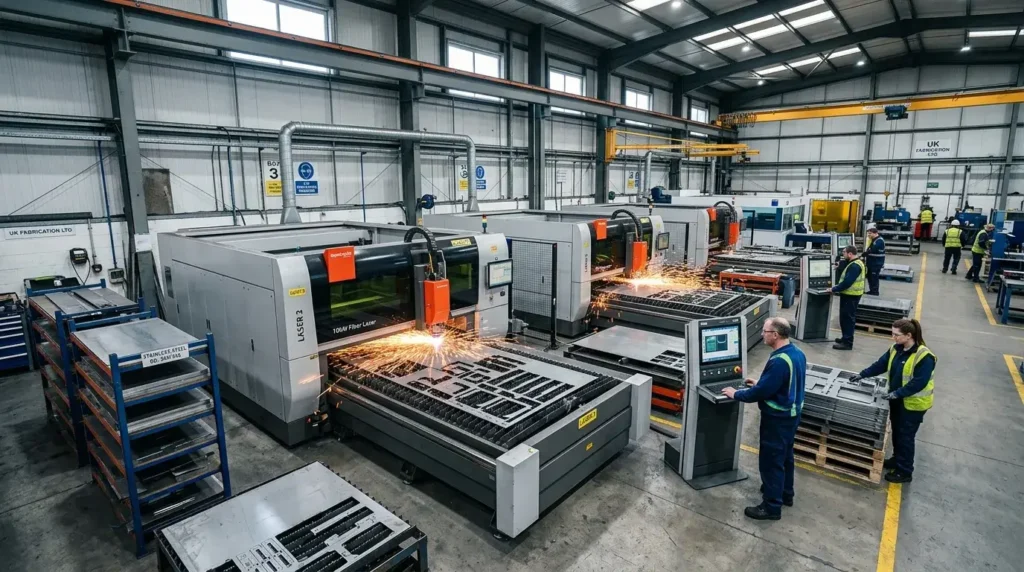
If you need precision laser cutting in the UK, the number of options can feel overwhelming. I’ve spent weeks researching this market — checking Companies House records[^1], reviewing certifications, reading real customer testimonials, and comparing machine capabilities. This guide ranks the 10 best laser cutting suppliers in the UK based on an 8-dimension scoring framework. I built this list for procurement managers, engineers, and OEM buyers who need more than a Google search to make confident sourcing decisions. Every company here was evaluated on verifiable evidence. Not marketing claims. How I Evaluated These Laser Cutting Suppliers I scored each company across eight dimensions. Each dimension carries a specific weight based on what matters most to B2B buyers placing real orders. Dimension Weight What I Assessed Scale & Capacity 20% Number of machines, facility size, staff count, production hours Service Range 15% Cutting methods, secondary operations, finishing options Certifications & Compliance 15% ISO standards, EN 1090, UKCA marking, execution class level Client Reputation 15% Independent reviews, testimonials, repeat business evidence Industry Experience 10% Years in operation, technical depth, heritage Technology Investment 10% Laser power (kW), automation level, latest equipment Digital Presence & Accessibility 10% Website quality, quoting speed, response times Geographic Relevance 5% Location, delivery logistics, UK coverage I used at least four source types for each company: company websites, Companies House filings, industry association listings (such as AILU — the Association of Laser Users[^2] and Made in the Midlands), and independent customer reviews. Where I couldn’t verify a data point, I gave a conservative score. I’d rather underrate a company than overrate it. Quick Comparison Table: All 10 UK Laser Cutting Suppliers at a Glance Rank Company Location Score Founded Standout Feature 1 WEC Laser (WEC Group) Darwen, Lancashire 9/10 1979 UK’s largest laser operation 2 The Laser Cutting Company Sheffield 9/10 1981 40+ year heritage, 24hr production 3 SSC Laser Multiple UK locations 8/10 2000 Dedicated customer contacts 4 FC Laser Ilkeston, Derbyshire 8/10 1970s UK’s fastest-growing laser company 5 Subcon Laser Cutting Coventry 8/10 1988 5-axis 3D cutting specialist 6 Laser 24 Essex 8/10 c. 2000 15kW fibre laser power 7 Midtherm Laser Dudley, West Midlands 7/10 1985 EN 1090-1 Execution Class 4 8 Fractory Manchester (UK office) 7/10 2017 Digital manufacturing platform 9 LaserMaster Redruth, Cornwall 7/10 Established Full fabrication under one roof 10 Cut-Tec UK 7/10 c. 2002 Most material-diverse in the UK 1. WEC Laser (WEC Group) — Best Overall Laser Cutting Supplier in the UK Location: Darwen, Lancashire Founded: 1979 (laser division since 1998) Score: 9/10 — Industry Leader Website: laser-eng.com WEC Laser is the laser cutting division of WEC Group. This is the largest fabrication and engineering company in the UK. The numbers speak for themselves: over 1,050 staff, 760,000 sq ft of manufacturing space, and 10 production sites across Lancashire, Merseyside, Yorkshire, and the West Midlands. Why WEC Laser Ranks #1 I put WEC at the top because no other UK laser cutting company matches its scale and breadth. They operate 24+ flat-bed lasers (including Trumpf 24kW fibre machines — the first in Northern England), 4 tube lasers, and 24+ press brakes. That’s a level of capacity that can absorb large production runs without bottlenecks. Their certification list is extensive: ISO 9001:2015[^3], EN 15085 (Rail), EN 1090 (CE/UKCA), EN 3834 (Fusion Welding), ISO 45001, and ISO 14001. They serve aerospace, defence, nuclear, rail, oil & gas, and automotive sectors. These aren’t easy industries to supply. The compliance requirements alone filter out most competitors. WEC also runs its own in-house Apprentice Training Academy. This is the only facility of its kind in the UK for laser cutting. That investment in people matters. It means their operators are trained to a consistent standard, which directly affects cut quality and repeatability. What Buyers Should Know WEC’s strength is also its potential drawback. This is a large group. If you’re placing a small, one-off order, you may not get the same personal attention as a larger contract. Their primary base is in Lancashire, so logistics costs could be higher for buyers in Southern England. Best for: High-volume production, multi-process projects, defence/aerospace/rail applications. 2. The Laser Cutting Company — Best for Heritage and Thick-Material Capability Location: Sheffield, South Yorkshire Founded: 1981 Score: 9/10 — Industry Leader Website: lasercutting.co.uk The Laser Cutting Company is one of the oldest laser cutting operations in the UK. They’ve been running since 1981 — that’s over 40 years of continuous experience in metal profiling. Why They Score So High I scored them 9/10 mainly because of their range and production model. They run 10 laser cutting machines on 24-hour lights-out production. That gives them the turnaround speed of a much larger operation. They offer four different flatbed cutting methods under one roof: laser, waterjet, plasma, and flame. This means they can handle material thicknesses from 0.1mm up to 270mm. Their sister site, Charles Day Steels in Sheffield, houses the UK’s first 15kW laser cutting machine. Together, they can handle sheet sizes up to 6,000mm × 2,500mm. If you need bevel cutting, countersinking, flow drilling, or tapping, it’s all done in-house. That saves you from coordinating multiple suppliers. They hold ISO 9001 and BS/EN 1090-1 certifications. What Buyers Should Know Sheffield is well-connected by motorway, but deliveries to far South or Scotland may take an extra day. Their wide capability range is a strength, but it also means simpler jobs might queue behind more complex projects. Best for: Thick plate cutting, multi-method profiling, one-stop metalwork solutions. 3. SSC Laser — Best for Personalised Customer Service Location: Multiple UK sites Founded: 2000 Score: 8/10 — Strong Contender Website: ssclaser.co.uk SSC Laser has built its reputation over 25 years by treating every customer as a direct relationship, not a ticket number. Each key customer gets a dedicated point of contact. That level of service is rare in sub-contract cutting. Key Capabilities They operate 3 flat-bed lasers, 2 tube lasers, and 3 press brakes. Their Bystronic fibre laser is described as one of the UK’s
What Is Sheet Metal Fabrication? The Complete Process Explained Step by Step
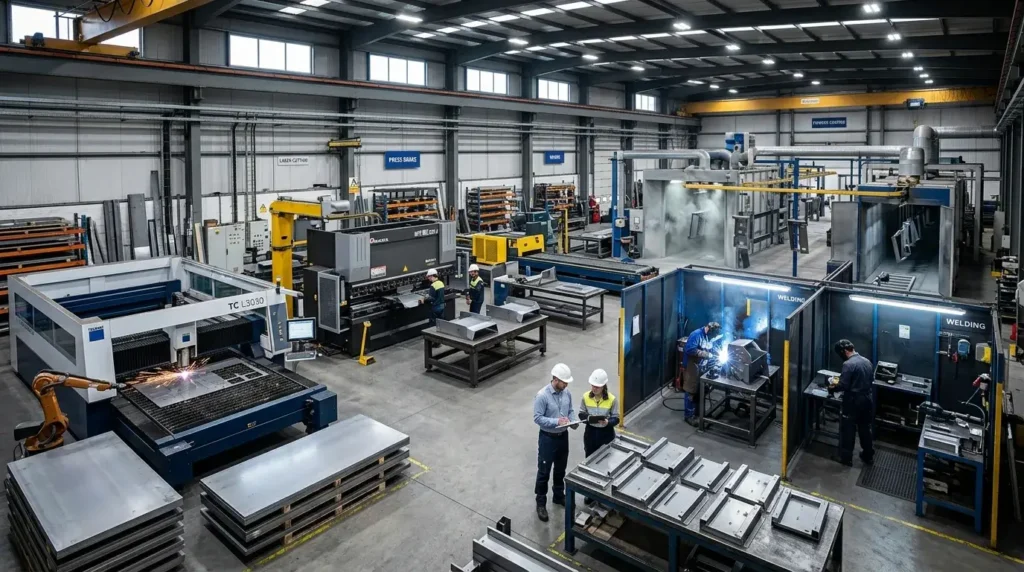
Every metal enclosure on a factory floor. Every bracket inside an elevator. Every stainless steel panel on a commercial kitchen wall. They all started as a flat sheet of metal. I run production at a sheet metal fabrication facility. Every day, I watch flat steel and aluminum transform into precise, functional parts. And every day, I talk to engineers and procurement managers who need a clear answer to the same question: what exactly is sheet metal fabrication, and how does the process work? This guide walks through every step — from raw material to finished part. No filler. No vague descriptions. Just the process as it actually happens on a production floor. Sheet metal fabrication is the process of turning flat metal sheets into finished parts and structures through cutting, bending, joining, and surface finishing. It is one of the most widely used manufacturing methods in the world. The global sheet metal fabrication services market[^1] was valued at approximately $10.3 billion in 2024 and is projected to reach $15.2 billion by 2034. Nearly every industry relies on it — from automotive to electronics to construction. What makes sheet metal fabrication different from other metalworking methods? Two things. First, it starts with flat sheets — typically between 0.5 mm and 6 mm thick. Anything thicker is usually called "plate." Second, it shapes the metal mainly through deformation (bending, forming) and removal (cutting), rather than carving from a solid block like CNC machining does. The result is lightweight, strong, and cost-effective parts. That is why it remains the backbone of modern manufacturing. What Materials Are Used in Sheet Metal Fabrication? The material you choose affects everything: strength, weight, corrosion resistance, weldability, cost, and even how the part bends. I see engineers make costly mistakes by picking the wrong material early in the design phase. Here is what we work with most often. Common Sheet Metal Materials Material Key Properties Common Applications Mild / Carbon Steel High strength, affordable, excellent weldability Structural brackets, enclosures, frames, machine guards Stainless Steel (304, 316) Corrosion resistant, hygienic, durable Medical equipment, food processing, outdoor architecture Aluminum (5052, 6061) Lightweight, corrosion resistant, good conductivity Electronics enclosures, aerospace brackets, heatsinks Galvanized Steel Zinc-coated for outdoor protection HVAC ductwork, roofing, outdoor electrical cabinets Copper Excellent electrical and thermal conductivity Bus bars, electrical connectors, heat exchangers Brass Corrosion resistant, aesthetic appeal Decorative panels, electrical components Steel dominates the market. It accounts for roughly 60% of material revenue in sheet metal fabrication services worldwide[^2]. But aluminum is the fastest-growing segment, driven by demand for lightweight parts in electric vehicles and consumer electronics. A practical tip from our shop floor: If your part needs bending, choose aluminum 5052 over 6061. The 5xxx series has higher ductility[^3] and bends without cracking. I have seen projects fail because an engineer specified 6061 without considering formability. That mistake costs time and money. Understanding Sheet Metal Gauge Thickness If you are new to sheet metal, the gauge system will confuse you. It confuses experienced buyers, too. Gauge is a number that represents thickness. But it is not a standard unit like millimeters or inches. It is a legacy system from the British wire industry. And here is the part that trips people up: a higher gauge number means a thinner sheet. Different metals use different gauge scales: Steel (carbon, stainless, galvanized) uses the Manufacturers’ Standard Gauge. Aluminum and other nonferrous metals use the Brown & Sharpe / American Wire Gauge (AWG) system. This means 18-gauge steel and 18-gauge aluminum are not the same thickness. For a full breakdown by material type, see this sheet metal gauge conversion chart[^4]. Quick Gauge Reference Gauge Carbon Steel (mm) Stainless Steel (mm) Aluminum (mm) 10 3.42 3.57 2.59 14 1.90 1.98 1.63 16 1.52 1.59 1.29 18 1.21 1.27 1.02 20 0.91 0.95 0.81 24 0.61 0.64 0.51 Why does gauge matter for your project? Thickness directly affects four things: Bending behavior — Thicker sheets need more force and a larger bend radius. Thin sheets bend easily but risk distortion. Weldability — Thin-gauge metals risk burn-through during welding. Welders must use controlled heat and shorter passes. Structural strength — Lower gauge (thicker) means higher load capacity and rigidity. Cost — Thicker material costs more per unit area and requires more powerful equipment. My recommendation: Always specify thickness in millimeters or inches on your engineering drawings. Do not rely on gauge numbers alone. This avoids miscommunication between your team and the fabricator. The Sheet Metal Fabrication Process: 6 Steps from Design to Delivery Every part we produce goes through a defined sequence. Some parts need all six steps. Others skip a step or two. But the overall flow is the same. Step 1 — Design and Engineering Every project starts with a design. This is where most problems are either prevented or created. An engineer creates a 3D CAD model of the part. That model gets converted into a flat pattern — a 2D layout of the part before bending. The flat pattern is then translated into machine code (G-code) that tells our CNC equipment exactly where to cut, punch, and bend. But before anything goes to production, we do a Design for Manufacturability (DFM) review. This is where we check the design for real-world issues: Bend radius — Is the inside bend radius at least equal to the material thickness? If not, the part may crack. Hole-to-bend distance — Holes too close to a bend line will deform during bending. We recommend a minimum of 2× material thickness. Minimum flange length — Short flanges cannot be gripped by the press brake tooling. We need at least 4× material thickness for a reliable bend. K-factor — This value predicts how much the material stretches during bending. It varies by material and method. Getting it wrong means the final part dimensions will be off. A solid DFM review saves weeks of rework. We catch 80% of production issues at this stage. For deeper guidance on these rules, Protolabs publishes an excellent sheet
Top 10 Sheet Metal Fabrication Companies in the USA
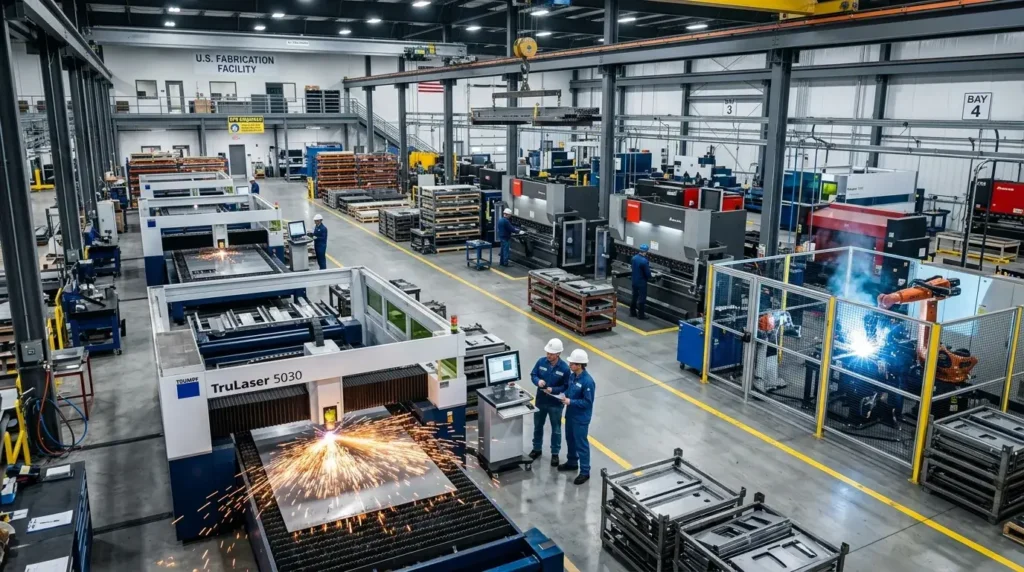
Choosing a sheet metal fabrication partner in the United States is a high-stakes decision. The wrong choice costs more than money. It costs rework, missed deadlines, and sometimes a delayed product launch. I researched over 25 U.S.-based sheet metal fabrication companies for this guide. I cross-referenced data from The Fabricator’s FAB 40 list, SEC filings, industry market reports, and direct company disclosures. Then I scored each company on eight weighted criteria that matter to OEM engineers and procurement teams. The result is a ranked list of the 10 best sheet metal fabrication service providers in the USA — with transparent methodology, verifiable data, and honest trade-offs for each company. How I Selected These Companies I used a structured evaluation process with data from multiple independent sources. Data Sources The Fabricator FAB 40[^1] (2023–2025 editions) — the most recognized revenue-based ranking of U.S. contract fabricators SEC filings for publicly traded companies (MEC, Xometry) Industry reports from Research and Markets and Technavio B2B directories including IQS Directory, ThomasNet, and MFG.com Company websites, LinkedIn profiles, and press releases Customer reviews and engineering community feedback Scoring Framework Each company was scored 1–10 across eight dimensions. Here is the framework: Dimension Weight What I Assessed Scale & Market Coverage 20% Revenue, facility count, geographic reach, employee count Product Line Completeness 15% Range of fabrication processes (cutting, forming, welding, finishing, assembly) Certifications & Compliance 15% ISO 9001[^2], AS9100D, ITAR, ISO 13485, CMMC, UL certifications Client Reputation & Reviews 15% FAB 40 rank, customer testimonials, OEM partnerships, industry awards Industry Influence 10% Trade show activity, media coverage, association involvement Supply Chain Capability 10% Lead times, MOQ flexibility, DFM support, digital quoting Digital Presence & Accessibility 10% Online quoting, website quality, communication responsiveness Geographic Relevance 5% Multi-location coverage, shipping logistics, nearshore options I grouped the final results into three tiers: Tier 1 — Industry Leaders (Score 9–10) Tier 2 — Strong Contenders (Score 7–8) Tier 3 — Noteworthy Specialists (Score 7) Note: Most companies on this list are privately held. Revenue figures are estimates based on the best available data. Independent verification is limited for private firms. Quick Comparison Table Here is every company at a glance. Use this to shortlist before reading the detailed profiles. Rank Company HQ Location Founded Est. Revenue Employees Score Best For 1 Mayville Engineering (MEC) Milwaukee, WI 1945 $582M (2024) 2,200+ 9/10 High-volume OEM production 2 Cadrex Manufacturing Romeoville, IL 1976 ~$480M 2,000+ 9/10 Data center & ICT hardware 3 BTD Manufacturing Detroit Lakes, MN 1979 ~$296–364M 1,300+ 8/10 Precision fabrication + tool & die 4 O’Neal Manufacturing (OMS) Vestavia Hills, AL 1921 ~$234–285M 1,100+ 8/10 Heavy industrial repetitive parts 5 Ironform Corporation Chicago, IL 2013 ~$210–240M 900+ 8/10 Heavy stamping + transportation 6 PEKO Precision Products Rochester, NY 1966 Not disclosed 400+ 8/10 Defense, medical, semiconductor 7 Anchor Fabrication Fort Worth, TX 1990 ~$54–100M+ 500+ 7/10 Heavy fab in South/Central U.S. 8 Maysteel Industries Allenton, WI 1936 ~$140–180M ~900 7/10 Enclosures & infrastructure 9 Xometry North Bethesda, MD 2013 $513M (2024) 1,000+ (corp) 7/10 On-demand digital ordering 10 SendCutSend Reno, NV 2018 Not disclosed — 7/10 Fast prototyping & small runs Detailed Company Profiles 1. Mayville Engineering Company (MEC) — Score: 9/10 Tier: Industry Leader Detail Info HQ Milwaukee, Wisconsin Founded 1945 Employees 2,200+ Revenue $582 million (2024, publicly reported) Facilities 20+ locations across the U.S. Certifications NYSE-listed (MEC), ITAR, ISO-compliant Website mecinc.com MEC has held the #1 spot on The Fabricator’s FAB 40 list[^3] for 15 consecutive years. That is the longest streak in the industry. No other contract fabricator in the U.S. has matched this consistency. As a publicly traded company, MEC offers fully verified financial data. Their 2024 annual revenue was $581.6 million. You can check this in their SEC filings[^4]. MEC is vertically integrated. They handle design, prototyping, fabrication, aluminum extrusion, coating, and assembly. This means fewer vendors in your supply chain. In 2025, MEC acquired Accu-Fab for $140.5 million. This moved them into the data center and critical power infrastructure markets. If your project involves power distribution enclosures or server hardware, MEC now competes directly in that space. Key strengths: 15 years as the #1 ranked U.S. contract fabricator (FAB 40) Full vertical integration from design to final assembly Publicly traded — transparent financials Serves six distinct end markets (commercial vehicles, construction, powersports, agriculture, military, data center) What to watch: Revenue declined slightly in 2024 (down 1.2%) due to softening demand Best suited for large OEM programs — not ideal for prototype-only projects Large organization — onboarding may take longer than with mid-sized shops 2. Cadrex Manufacturing Solutions — Score: 9/10 Tier: Industry Leader Detail Info HQ Romeoville, Illinois Founded 1976 (as CGI Automated Manufacturing) Employees 2,000+ Revenue ~$480 million (ranked #2 on FAB 40, 2023–2025) Facilities 22 locations in 9 U.S. states + Mexico (~1.6M sq ft) Certifications ISO 9001, AS9100D[^5], ITAR, BAE Systems Supplier of the Year Website cadrex.com Cadrex is the #2 contract fabricator in the U.S. by revenue. They have held that position on the FAB 40 since 2023. What makes Cadrex different is their geographic footprint. They operate 22 facilities across nine states and Mexico. That is the widest spread of any dedicated sheet metal fabricator in North America. Cadrex is backed by CORE Industrial Partners. Through more than 10 acquisitions, they have built a platform that spans sheet metal fabrication, precision machining, stamping, plastic injection molding, and full electromechanical assembly. Their strongest sector is data center and ICT hardware. They manufacture custom server rack components and enclosures for hyperscale cloud companies. If your project involves telecom, networking, or electrical infrastructure, Cadrex has purpose-built capabilities. Key strengths: 22-facility North American footprint — the broadest among dedicated sheet metal fabricators Strong data center and ICT specialization Mirrored U.S.–Mexico capabilities for cost optimization and scale flexibility BAE Systems Supplier of the Year — validated defense-sector performance What to watch: Privately held — revenue based on self-reporting, not independently audited Rapid acquisitions mean some legacy brands are still integrating Heavy ICT concentration could
Top 10 Best Sheet Metal Fabrication Companies in China (2026 Buyer’s Guide)
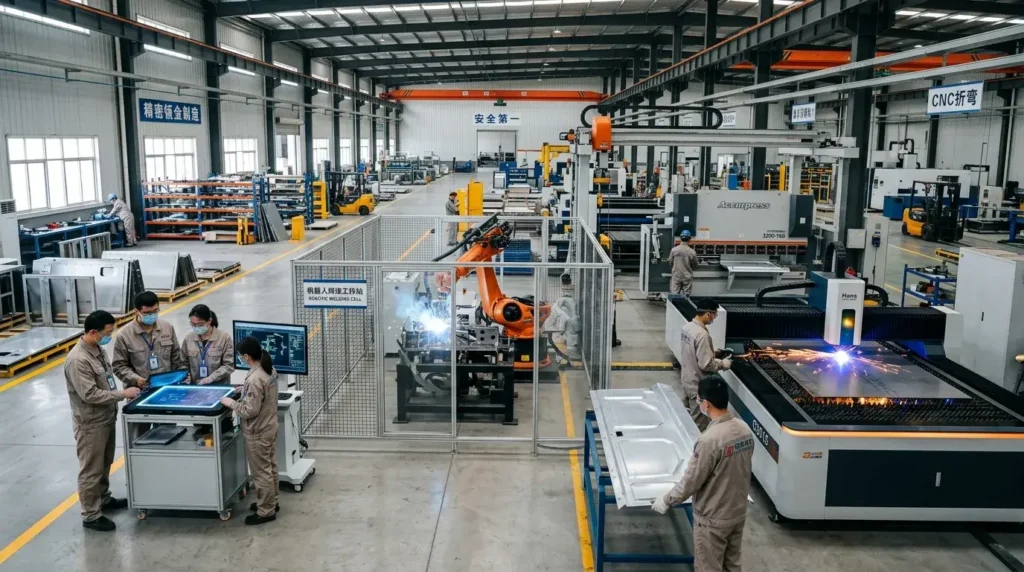
Sourcing sheet metal parts from China can cut your production costs by 30–50%. But picking the wrong fabrication partner can cost you far more — in scrapped parts, missed deadlines, and damaged client relationships. I’ve seen it happen. An OEM sends drawings to a factory with a great-looking website. Samples come back acceptable. Then the production run arrives with inconsistent tolerances, poor weld quality, and zero documentation. The factory stops responding. The buyer starts over — months behind schedule. The root of the problem is information. There are thousands of sheet metal fabricators in China. Most look identical online. Self-reported factory sizes. Unverifiable client lists. Expired certifications on flashy websites. Without reliable data, choosing a supplier feels like guessing. That’s why I built this guide. I researched over 25 candidates across company websites, B2B platforms, LinkedIn profiles, third-party databases, and industry publications. I scored each company on 8 weighted dimensions. Every entry includes honest buyer considerations — not just marketing highlights. If you’re an engineer, procurement manager, or OEM buyer sourcing custom sheet metal parts from China, this list gives you a real starting point. How These Companies Were Selected I evaluated candidates across 4+ source types: company websites, B2B platform listings (Alibaba, Made-in-China), third-party databases (Metoree, Ensun, Crunchbase), and industry media. A note on data quality: most company data in this space is self-reported. Factory sizes, client lists, and delivery rates are rarely audited by third parties. I’ve noted where independent verification is available. Treat all claims as a starting point for your own due diligence. Evaluation Criteria The global metal fabrication market reached over $20 billion in 2023[^1] and continues to grow. China holds the largest share. With that scale comes thousands of suppliers — and wide variation in quality. I used 8 dimensions with weighted scoring to evaluate each candidate: Dimension Weight What I Assessed Scale & Market Coverage 20% Factory size, workforce, export countries, production volume Product Line Completeness 15% Range of fabrication services and material capabilities Certifications & Compliance 15% ISO, IATF, AS9100, CE, RoHS certifications Client Reputation & Reviews 15% Named clients, verified partnerships, testimonials Industry Influence 10% Trade show presence, media coverage, industry recognition Supply Chain Capability 10% Lead times, MOQ flexibility, on-time delivery track record Digital Presence & Accessibility 10% Website quality, English support, quoting systems Geographic Relevance 5% Port access, industrial cluster advantages, logistics Each dimension scored 1–10. The weighted total gives a final score out of 10. Quick Comparison Table Rank Company Location Founded Score Best For 1 Komaspec (Komacut) Guangzhou 2005 9.2 Turnkey contract manufacturing 2 RapidDirect Shenzhen 2009 8.8 Rapid prototyping & digital ordering 3 Masion Ningbo 2007 8.6 Vertically integrated production 4 KDM Fabrication Wuxi 2006 8.3 Enclosures & industrial cabinets 5 SUPRO MFG Shanghai 2006 8.1 Custom brackets & structural parts 6 Anebon Metal Dongguan 2010 7.9 Precision CNC + sheet metal 7 TUOFA Precision Shenzhen 2006 7.7 Automotive-grade fabrication 8 3ERP Zhongshan ~2015 7.5 Prototyping & small batches 9 Maxtech Manufacturing Shanghai 2000 7.3 Multi-process generalist 10 Yijin Hardware Shenzhen 2003 7.1 CNC machining + sheet metal 1. Komaspec (Komacut) — Guangzhou Score: 9.2 / 10 — Tier 1: Industry Leader Founded: 2005 | Employees: 325+ | Facilities: 190,000 sq ft across 6 buildings Komaspec is a Canadian-owned contract manufacturer based in Guangzhou. They operate facilities in China, Vietnam, and Mexico. This multi-regional setup allows buyers to diversify their supply chain across three countries under one quality system. Key Capabilities Produces over 6 million precision parts annually for global OEMs. Industry 4.0 smart factory[^2] with real-time monitoring from quote to shipment. Komacut online platform provides instant quotes, DFM feedback, and order tracking. Equipment includes LVD press brakes, 12kW fiber laser cutters, and robotic welding cells. ISO 9001:2015[^3] certified. Buyer Considerations Komaspec focuses on high-mix, medium-volume work — typically batches of 500–5,000 parts across many SKUs. Pricing reflects Western management standards. For prototype-only projects with very low quantities, a smaller specialist may offer faster turnaround. Industries: Agriculture, mining, automotive, fitness equipment, consumer goods, construction. Website: komaspec.com 2. RapidDirect — Shenzhen Score: 8.8 / 10 — Tier 1: Industry Leader Founded: 2009 | Factory: 20,000 m² in-house + 50 partner facilities RapidDirect built their business around a digital-first model. Their AI-powered quoting engine accepts CAD uploads and returns pricing with DFM feedback[^4] in minutes. That speed is useful when comparing multiple suppliers simultaneously. Key Capabilities 20,000+ customers across 120+ countries. Sheet metal prototype lead times as short as 3 days. Four certifications: ISO 9001:2015, ISO 13485, ISO 14001, IATF 16949[^5]. No MOQ. Handles single prototypes through high-volume production. Finishing options include anodizing, powder coating, electroplating, polishing, and painting. Buyer Considerations RapidDirect uses a hybrid factory + network model. They have their own factory and also route jobs to vetted partner shops. This provides scale but introduces variability. Ask which specific facility will handle your parts if consistency is critical. Industries: Automotive, aerospace, medical devices, electronics, consumer products. Website: rapiddirect.com 3. Masion — Ningbo Score: 8.6 / 10 — Tier 1: Industry Leader Founded: 2007 | Facility: 30,000 m² with 6 production plants | Employees: 400+ Masion runs a fully vertically integrated operation. Every process — laser cutting, stamping, bending, welding, plastic injection, surface treatment, and assembly — happens in-house under one roof. Key Capabilities 6 production plants and 6 assembly lines in Ningbo. Serves major OEMs: Geely Auto, Lixiang Auto, CRRC, AUX, Costco. Team includes 15 R&D engineers, 20 mold engineers, 7 manufacturing engineers. Holds 47 patents for product designs. ISO/TS 16949 certified (automotive-grade quality systems). Buyer Considerations Masion’s client base is primarily domestic Chinese OEMs with growing international reach. English-language communication may require extra specification clarity. Their single-location concentration in Ningbo offers no geographic diversification. Industries: Automotive, transportation, home appliances, consumer goods. Website: sheetmetalmasion.com 4. KDM Fabrication — Wuxi Score: 8.3 / 10 — Tier 2: Strong Contender Founded: 2006 | Factory: 8,000+ m² | Location: Huishan District, Wuxi, Jiangsu KDM has deep expertise in metal enclosures and industrial cabinets. If your project involves electrical