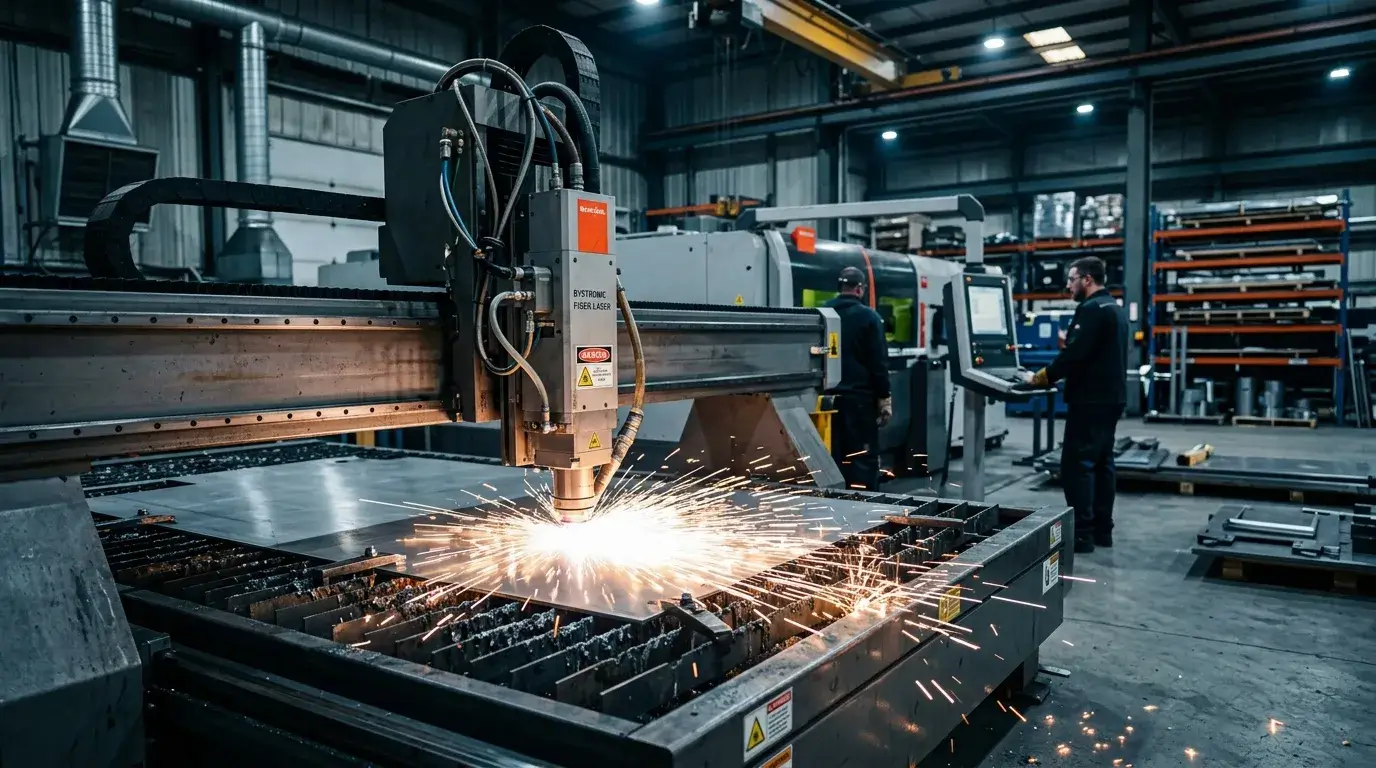
I've watched laser cutting transform from a specialty process into the backbone of modern sheet metal fabrication. At our facility, laser cutting is the first production step for about 85% of all parts we manufacture. It sets the foundation for everything that follows — bending, welding, finishing, and assembly.
But here's the thing most guides won't tell you: laser cutting alone doesn't make a great part. The real value comes from how cutting integrates with your entire fabrication workflow — and how well your supplier understands that connection.
This guide covers everything I've learned running laser cutting operations for OEM and ODM customers worldwide. I'll walk you through how the process actually works, which laser type fits your project, what materials cut best, how to design parts that save you money, and how to pick a supplier who won't waste your time.
How Laser Cutting Actually Works in Sheet Metal Fabrication
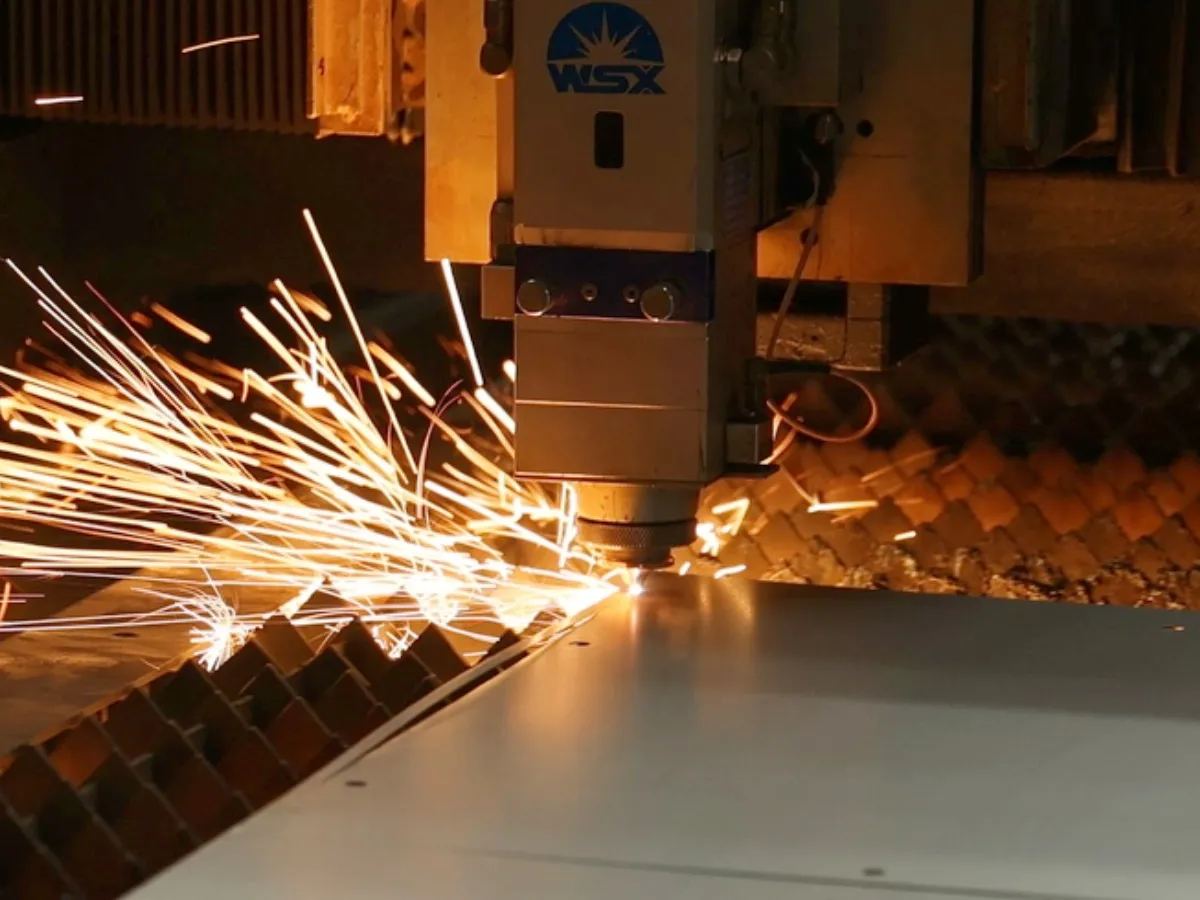
Laser cutting is a thermal process. A focused beam of light heats sheet metal to the point where it melts, burns, or vaporizes along a programmed path. A CNC system controls the movement. An assist gas — usually nitrogen or oxygen — blows the molten material out of the cut zone.
That's the textbook version. Here's what it means in practice.
The laser beam hits a spot roughly 0.1 mm wide. The energy density at that point is extreme. The metal doesn't just melt — it disappears. The CNC system moves the cutting head along the exact path defined in your CAD file. The result is a cut edge that's clean, precise, and often needs zero secondary processing.
Three things control the quality of every cut:
- Laser power — determines how thick you can cut and how fast
- Cutting speed — too fast leaves rough edges; too slow creates excessive heat
- Assist gas type and pressure — nitrogen gives clean oxidation-free edges; oxygen cuts faster but leaves a thin oxide layer
I think of it like this: the laser does the cutting, but the gas does the cleaning. Get the gas wrong, and even a perfect laser setup produces parts with discolored edges or micro-burrs.
Fiber Laser vs. CO₂ Laser: Which One Should You Care About?
If you're sourcing sheet metal parts in 2025, you almost certainly want fiber laser cutting. Here's why.
The Shift That Changed Everything
CO₂ lasers dominated sheet metal cutting for decades. They use a gas mixture to generate a laser beam at 10.6 μm wavelength. They work. But they're being replaced — fast.
Fiber lasers[^1] generate a beam at 1.06 μm wavelength through a fiber optic cable doped with rare-earth elements. That shorter wavelength is absorbed more efficiently by metals. The result: faster cutting, lower energy bills, and less maintenance.
Head-to-Head Comparison
| Factor | Fiber Laser | CO₂ Laser |
|---|---|---|
| Wall-plug efficiency | ~30–40% | ~10–15% |
| Cutting speed (thin sheet ≤3 mm) | 3–5× faster | Baseline |
| Cutting speed (thick plate ≥12 mm) | Comparable or faster | Historically preferred, now overtaken |
| Maintenance | Minimal — no mirrors, no gas refills | Regular mirror alignment, gas refills |
| Operating cost per hour | ~$15–25 | ~$30–50 |
| Best for metals | Steel, stainless, aluminum, copper, brass | Steel, stainless (struggles with reflective metals) |
| Non-metal cutting | Not suitable | Good (wood, acrylic, plastics) |
I upgraded our facility to all-fiber laser machines three years ago. Our electricity costs dropped by roughly 40%. Our cutting speed on stainless steel under 6 mm doubled. And our maintenance downtime went from ~8 hours per month to under 2.
A key reason for this performance gap is how metals absorb different laser wavelengths[^2]. Aluminum, for example, absorbs roughly seven times more radiation from a fiber laser than from a CO₂ laser. That difference in absorption translates directly to cutting speed and energy efficiency.
Bottom line for buyers: Unless you need non-metal cutting, fiber laser is the standard. If your supplier is still running CO₂ lasers on your metal parts, ask why.
What Materials Can You Laser Cut?
Laser cutting handles most metals used in sheet metal fabrication. But "can cut" and "cuts well" are two different things. Here's what I see on our production floor every day.
Material Compatibility Table
| Material | Common Grades | Max Practical Thickness (Fiber) | Cut Quality | Notes |
|---|---|---|---|---|
| Carbon/mild steel | SPCC, SPHC, Q235, Q345 | 25–30 mm | Excellent | Oxygen assist gives fast cuts; nitrogen for clean edges |
| Stainless steel | SUS304, SUS316, SUS430 | 20–25 mm | Excellent | Nitrogen assist required for bright, oxide-free edges |
| Aluminum | 5052, 6061, 5083 | 16–20 mm | Good | Reflective — requires higher power; edges can be slightly rougher |
| Copper | C1100, C1020 | 8–10 mm | Fair | Highly reflective; needs high-power fiber laser (6 kW+) |
| Brass | C2680, C2801 | 8–10 mm | Good | Cuts well but produces fumes; good ventilation required |
| Galvanized steel | SGCC, DX51D | 6–8 mm | Good | Zinc coating vaporizes during cutting; may need edge cleanup |
A Note on Thickness vs. Quality
I want to be honest about something. Many suppliers advertise maximum cutting thickness as if it's a selling point. "We can cut 30 mm steel!" Sure. But can they cut it with the edge quality your part actually needs?
Here's the reality: as thickness increases, edge quality decreases. A 1 mm stainless steel cut looks mirror-smooth. A 20 mm cut has visible striations and may need grinding before welding. For most sheet metal fabrication projects, the sweet spot is 0.5 mm to 12 mm. That's where laser cutting delivers the best balance of speed, precision, and cost.
How to Design Parts That Cut Faster and Cost Less
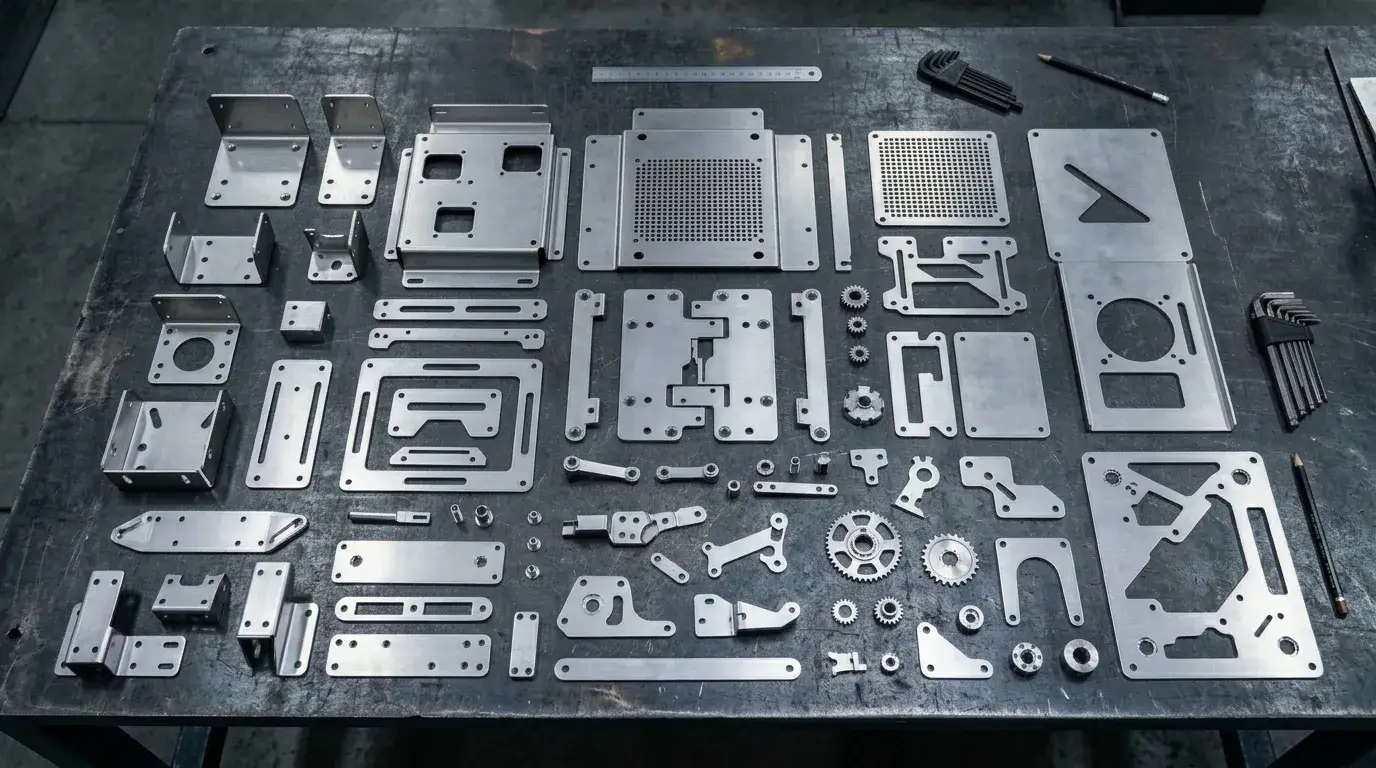
This is where I see the biggest gap between experienced engineers and first-time buyers. Small design decisions have a huge impact on laser cutting cost and quality.
Minimum Hole Diameter
The general rule: minimum hole diameter = material thickness. So a 2 mm sheet needs holes at least 2 mm in diameter. Going smaller is possible but slows the process and increases cost.
Minimum Feature Spacing
Keep at least 2× material thickness between cut lines. Closer spacing causes heat buildup. The metal distorts. Parts warp. Tabs and slots that are too narrow break during handling.
Kerf Compensation
The laser beam removes material as it cuts. This removed width is called the kerf — typically 0.1–0.3 mm[^3] depending on material and thickness. Your CAD file should account for this. If you're designing mating parts (like tab-and-slot assemblies), offset your cut paths by half the kerf width.
Most fabricators handle kerf compensation during nesting. But if you're providing ready-to-cut DXF files, confirm with your supplier whether they expect kerf-compensated or nominal geometry.
Bend Proximity Rules
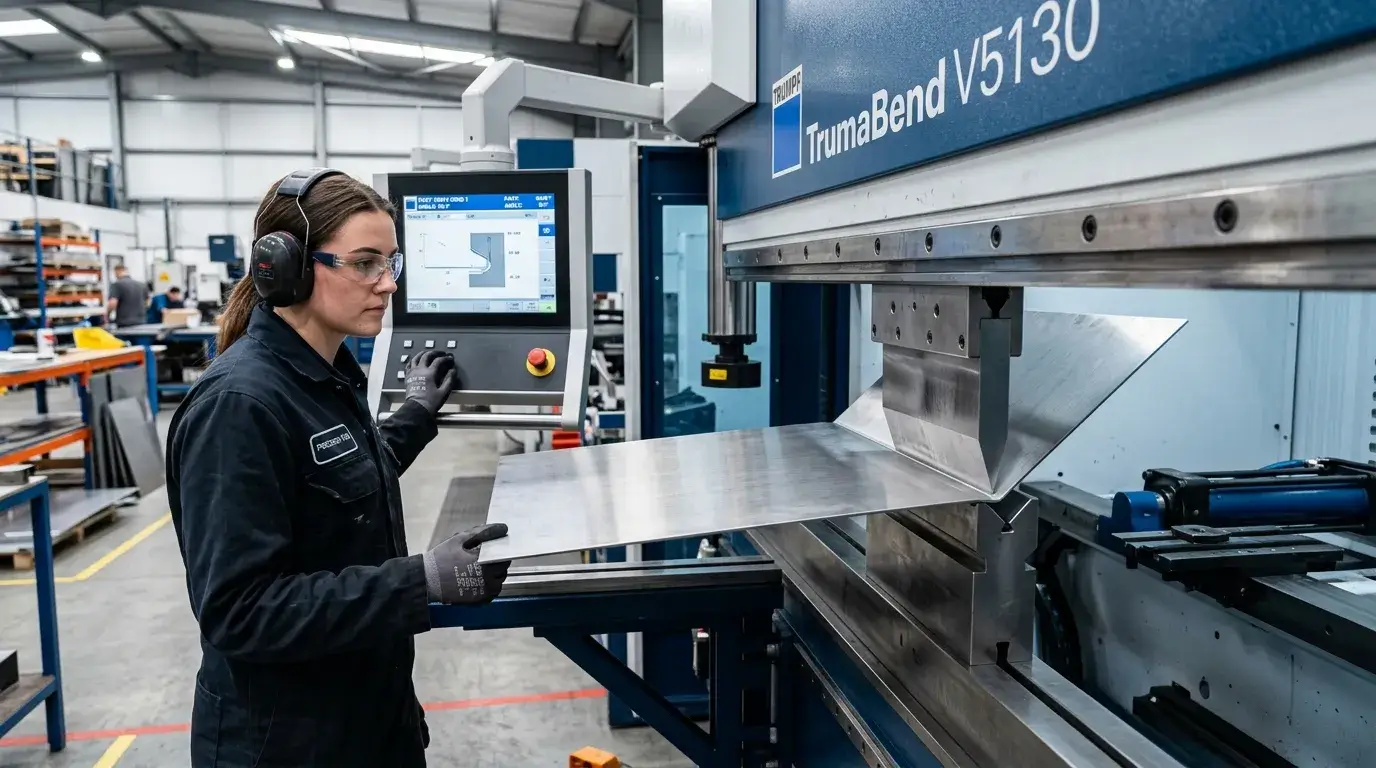
If your part gets bent after cutting, keep holes and cutouts at least 1.5–2× material thickness from the bend line. Holes placed too close to bends deform during the bending process.
Corner Design
Sharp internal corners are a problem. The laser has to decelerate, stop, and change direction — creating heat buildup at the corner. I recommend a minimum internal corner radius of 0.5 mm (or material thickness, whichever is greater). This small radius costs nothing extra and prevents micro-cracking.
Cost-Saving Design Tips Summary
| Design Move | Impact on Cost | Why |
|---|---|---|
| Use consistent hole sizes | Reduces pierce count | Fewer unique piercing parameters = faster cutting |
| Avoid unnecessary internal cutouts | Reduces pierce count | Every cutout requires a separate pierce operation |
| Round internal corners (R ≥ 0.5 mm) | Improves quality | Prevents deceleration burns and micro-cracks |
| Design for standard sheet sizes | Reduces scrap | 1220 × 2440 mm and 1500 × 3000 mm are most common |
| Keep spacing ≥ 2× material thickness | Prevents distortion | Heat management keeps parts flat |
Laser Cutting Tolerances: What's Realistic?
This is one of the most common questions I get from new customers. And the honest answer is: it depends on your material and thickness.
General Tolerance Guidelines
| Material Thickness | Typical Cutting Tolerance | Positioning Accuracy |
|---|---|---|
| 0.5–3 mm | ±0.05–0.10 mm | ±0.03 mm |
| 3–6 mm | ±0.10–0.15 mm | ±0.05 mm |
| 6–12 mm | ±0.15–0.25 mm | ±0.05 mm |
| 12–20 mm | ±0.25–0.50 mm | ±0.10 mm |
These numbers represent what a well-maintained machine with a skilled operator can achieve consistently. Tighter tolerances are possible on individual parts — but they require slower cutting speeds, more inspection, and higher cost.
My advice: don't over-specify tolerances. If your part functions fine at ±0.15 mm, don't call out ±0.05 mm just because it feels more precise. Tighter tolerances cost more to cut and inspect. Save your tight callouts for the features that actually need them.
Laser Cutting vs. Other Cutting Methods
Laser isn't always the best option. Here's how it compares to the other cutting methods we use and encounter.
| Factor | Laser Cutting | Plasma Cutting | Waterjet Cutting | CNC Punching |
|---|---|---|---|---|
| Typical tolerance | ±0.05–0.25 mm | ±0.5–1.5 mm | ±0.1–0.25 mm | ±0.1–0.2 mm |
| Edge quality | Excellent | Moderate | Excellent (no HAZ) | Good (slight rollover) |
| Material thickness (practical) | 0.5–25 mm | 6–50 mm | 1–150 mm | 0.5–6 mm |
| Speed (thin sheet) | Very fast | Moderate | Slow | Very fast (repetitive patterns) |
| Heat-affected zone | Small (0.1–0.5 mm) | Large (1–3 mm) | None | None |
| Setup time | Low (digital file) | Low | Low | Moderate (tooling setup) |
| Best for | Precision parts, complex shapes, mixed batch production | Thick plate, structural steel | Heat-sensitive materials, composites, very thick metal | High-volume panels with repetitive hole patterns |
My rule of thumb: If your material is under 12 mm and your parts have complex geometry, laser cutting is almost always the right choice. For repetitive hole patterns on thin panels, CNC punching may beat laser on cost. For thick plate over 25 mm or heat-sensitive materials, waterjet is worth considering.
How Laser Cutting Fits Into a Full Fabrication Workflow
Here's something that matters more than most buyers realize: laser cutting is just Step 1.
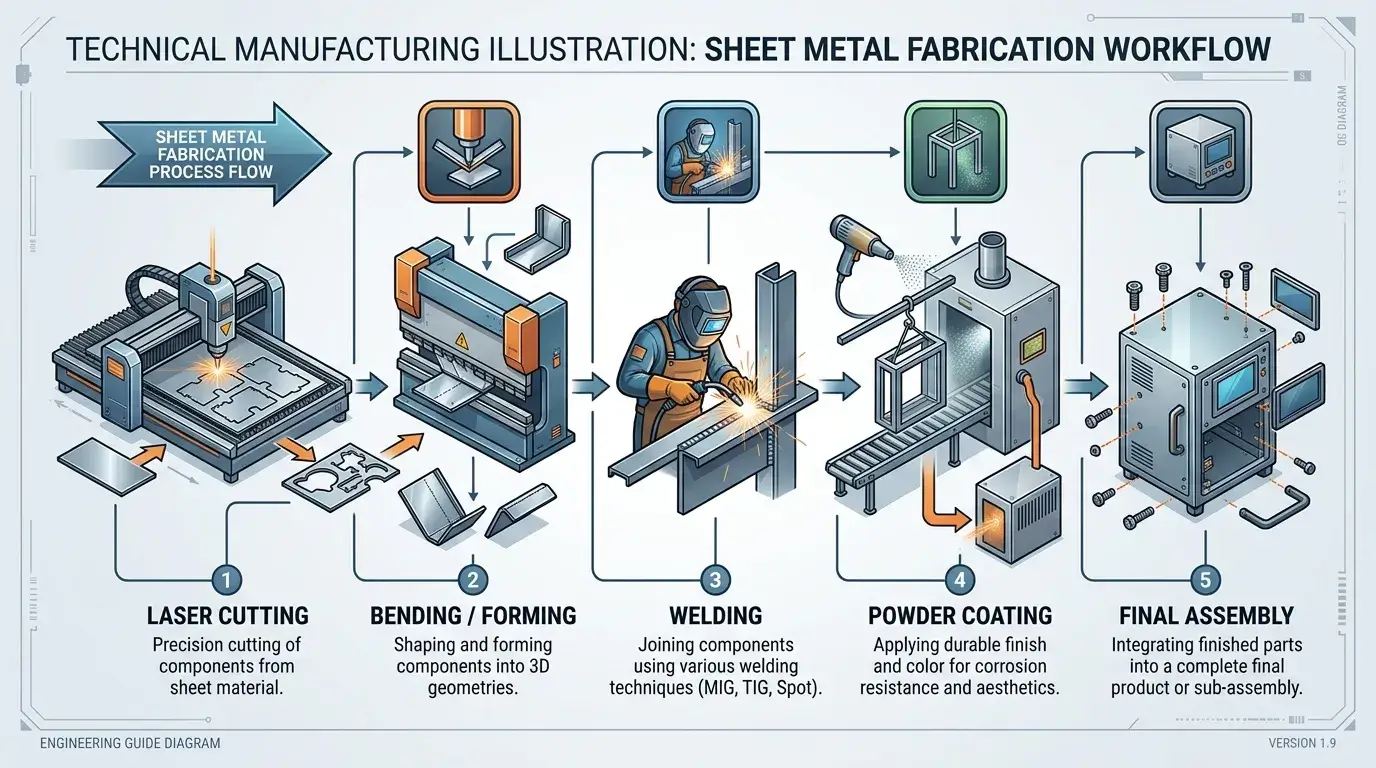
At our facility, a typical part goes through this sequence:
- Design review (DFM) — We check your drawings for manufacturability issues before cutting starts
- Laser cutting — Flat blanks are cut from sheet stock
- Deburring — Edges are cleaned and smoothed
- CNC bending — Flat blanks become 3D parts on press brakes
- Welding — Multiple parts are joined (MIG, TIG, or robotic welding)
- Surface finishing — Powder coating, plating, anodizing, or painting
- Assembly and inspection — Parts are assembled, measured, and packed
The reason this matters for buyers: choosing a supplier who only does laser cutting means you're managing multiple vendors. Every handoff between vendors adds lead time, communication overhead, and quality risk.
When we cut a part, we already know how it's going to be bent, where the weld joints are, and what the final finish requires. That knowledge feeds back into the cutting process. We adjust cut paths to account for bend deformation. We add weld prep chamfers during cutting. We orient grain direction based on the bending sequence.
A laser-only shop can't do this. They cut to a file and ship a blank. What happens next is your problem.
As The Fabricator reports[^4], the most competitive fabricators today are integrating laser cutting with automation and downstream processes — not just buying faster machines.
How to Evaluate a Laser Cutting Supplier
After years of being on the manufacturing side, here are the questions I'd ask if I were the buyer.
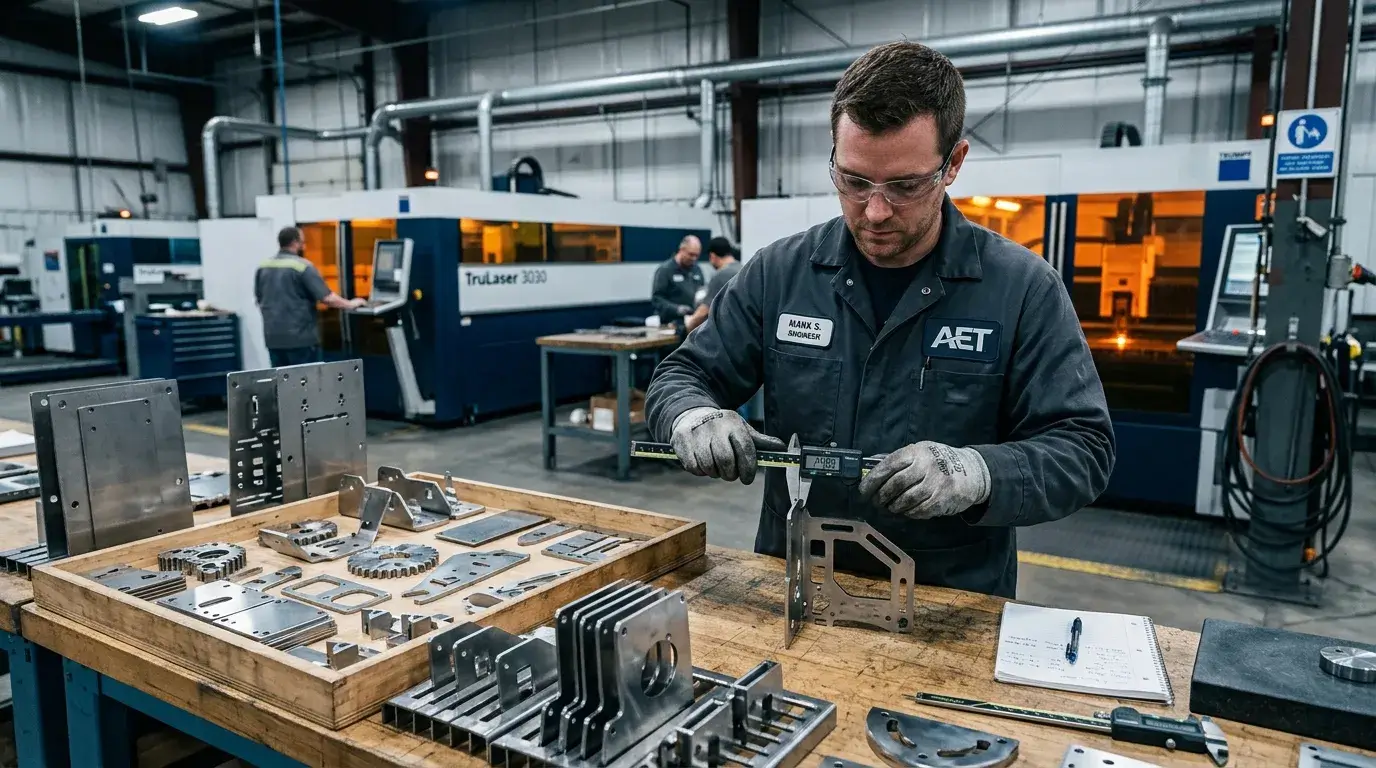
Ask About Equipment, Not Just Capability
"We can cut 20 mm stainless" is meaningless without context. Ask:
- What brand and power of fiber laser do they run? (TRUMPF, Bystronic, Amada, and Han's Laser are among the leading manufacturers in the global laser cutting market[^5].)
- What's the bed size? (Standard 1500 × 3000 mm handles most jobs. Larger beds like 2000 × 4000 mm reduce setups for big parts.)
- How many machines do they have? (Single-machine shops create bottlenecks.)
Ask About Process Integration
- Do they do bending, welding, and finishing in-house?
- Can they do DFM review before production?
- Do they provide first article inspection reports?
Ask About Quality Systems
- Are they ISO 9001 certified[^6]? This is the internationally recognized standard for quality management systems, with over one million certificates issued worldwide.
- What inspection equipment do they use? (CMM, laser scanner, digital calipers, and go/no-go gauges are standard.)
- Can they provide material certifications and test reports?
Ask for Sample Parts
Nothing replaces seeing the actual work. Request a sample or a trial run. Look at edge quality. Measure critical dimensions. Check for burrs. This tells you more than any brochure.
What Laser Cutting Costs (And What Drives the Price)
I won't give you a generic "it depends" answer. Here are the actual cost drivers.
The Big Five Cost Factors
| Cost Driver | Impact | What You Control |
|---|---|---|
| Material type and thickness | 30–50% of total cost | Choose standard grades; avoid exotic alloys when possible |
| Machine time (cutting speed) | 20–30% of total cost | Simplify geometry; reduce pierce count |
| Assist gas (nitrogen vs. oxygen) | 5–15% of total cost | Nitrogen costs more but gives clean edges; oxygen is cheaper |
| Setup and programming | 5–10% of total cost | Provide clean DXF/STEP files; batch similar parts |
| Nesting efficiency (material yield) | 5–15% of total cost | Design for standard sheet sizes; allow parts to nest tightly |
Rough Pricing Indicators
For reference, here's what typical laser cutting costs look like at volume (these are ballpark figures — actual pricing depends on your specific part):
- Simple flat parts (mild steel, 2 mm, 200 × 200 mm, 500 pcs): ~$0.30–0.80 per part
- Medium-complexity parts (stainless steel, 3 mm, multiple cutouts, 200 pcs): ~$1.50–4.00 per part
- Complex parts (aluminum, 6 mm, tight tolerances, 50 pcs): ~$5.00–15.00 per part
These ranges assume a competitive supplier in a major manufacturing region. Prototype quantities (1–10 pcs) cost significantly more per part due to setup and minimum order charges.
Common Laser Cutting Defects and How to Avoid Them
Even the best process produces defects if the setup or design is wrong. Here are the ones I see most often — and what causes them.
Burrs
Burrs form when molten metal doesn't fully eject from the cut. Causes: worn nozzle, incorrect gas pressure, or cutting too fast. Solution: regular nozzle inspection and proper parameter tuning. Light deburring after cutting handles minor cases.
Dross (Slag on the Bottom Edge)
This is molten metal that resolidifies on the underside of the cut. Common on thicker materials. Causes: insufficient gas pressure, focus point too high, or cutting speed too slow. Most dross can be removed by hand or with a tumble deburr process.
Heat Distortion (Warping)
Thin parts with large cut-to-area ratios are prone to warping. The heat from cutting causes uneven thermal expansion. Solutions: optimize cutting sequence (cut outward from center), use micro-tabs to hold parts in the sheet, and allow cooling time between nested parts.
Striation Lines
Visible lines on the cut edge. All laser cutting produces some striations — they're a natural artifact of the pulsed energy delivery. They become more visible on thicker materials. Oxygen cutting produces more pronounced striations than nitrogen cutting.
The Future of Laser Cutting in Sheet Metal Fabrication
The laser cutting market is growing fast. According to industry market research[^7], fiber laser technology has improved significantly in terms of beam quality and electrical efficiency since its commercial introduction around the year 2000, and today's systems routinely exceed 20 kW in output power.
Three trends I'm watching closely:
- AI-powered process optimization — machines that adjust cutting parameters in real time based on material feedback, reducing scrap and improving edge quality automatically.
- Higher power levels — 30 kW+ fiber lasers are making thick-plate cutting faster and more accessible, closing the last gap where plasma and oxy-fuel still had an edge.
- Coil-fed laser cutting — systems that cut directly from coil stock instead of pre-cut sheets, eliminating a material handling step and reducing waste.
For buyers, this means better parts, faster delivery, and lower costs — as long as you work with suppliers who invest in current technology.
Conclusion
Laser cutting is the starting point for precision sheet metal fabrication. It's fast, accurate, and flexible. But the technology is only as good as the people and processes behind it.
The best results come from suppliers who understand the full picture — not just cutting, but how every downstream process interacts with the cut part. DFM review, proper material selection, integrated bending and welding, quality inspection at every stage. That's what turns a flat blank into a finished product.
If you're evaluating a laser cutting supplier, don't just ask about machine specs. Ask how they connect cutting to the rest of your production. That's where the real value lives.
Need precision laser-cut parts for your next project? Request a quote from ZAKFAB — we review every design for manufacturability before production begins, and our integrated facility handles cutting, bending, welding, and finishing under one roof.
[^1]: Wikipedia's fiber laser article provides a thorough technical overview of how fiber lasers work, their advantages over other laser types, and why their flexible beam delivery and high output power make them dominant in industrial cutting applications.
[^2]: Laser Photonics explains the science behind why fiber lasers cut metals more efficiently than CO₂ lasers — including the critical difference in wavelength absorption rates across different metal surfaces.
[^3]: Fractory's kerf comparison guide defines cutting kerf across multiple processes (laser, plasma, waterjet, flame cutting) with specific width measurements, helping engineers understand how material removal affects final part dimensions.
[^4]: The Fabricator, one of the sheet metal industry's most respected trade publications, explores how modern fabricators are growing by integrating laser cutting with automation, AI-assisted quality monitoring, and downstream process connectivity.
[^5]: Global Market Insights' laser cutting machines market report provides verified data on market size ($5.94 billion in 2023), growth projections (7.6% CAGR through 2032), and profiles of leading industry players — useful context for understanding supplier credibility.
[^6]: ISO.org's official ISO 9001 page explains the globally recognized quality management standard that over one million organizations have been certified to — a critical credential to verify when evaluating any fabrication supplier.
[^7]: ScienceDirect's technical review of fiber laser systems covers the evolution of fiber laser power scaling from 100 W in 2000 to 17 kW+ by 2005, and the wavelength properties (1.06–1.08 μm) that make fiber lasers effective for cutting nearly all industrial metals and alloys.
[^8]: The American Society for Quality (ASQ) provides an accessible explanation of ISO 9001 requirements, certification processes, and the business benefits of quality management systems — particularly relevant for buyers assessing whether a supplier's quality claims are backed by real certification.