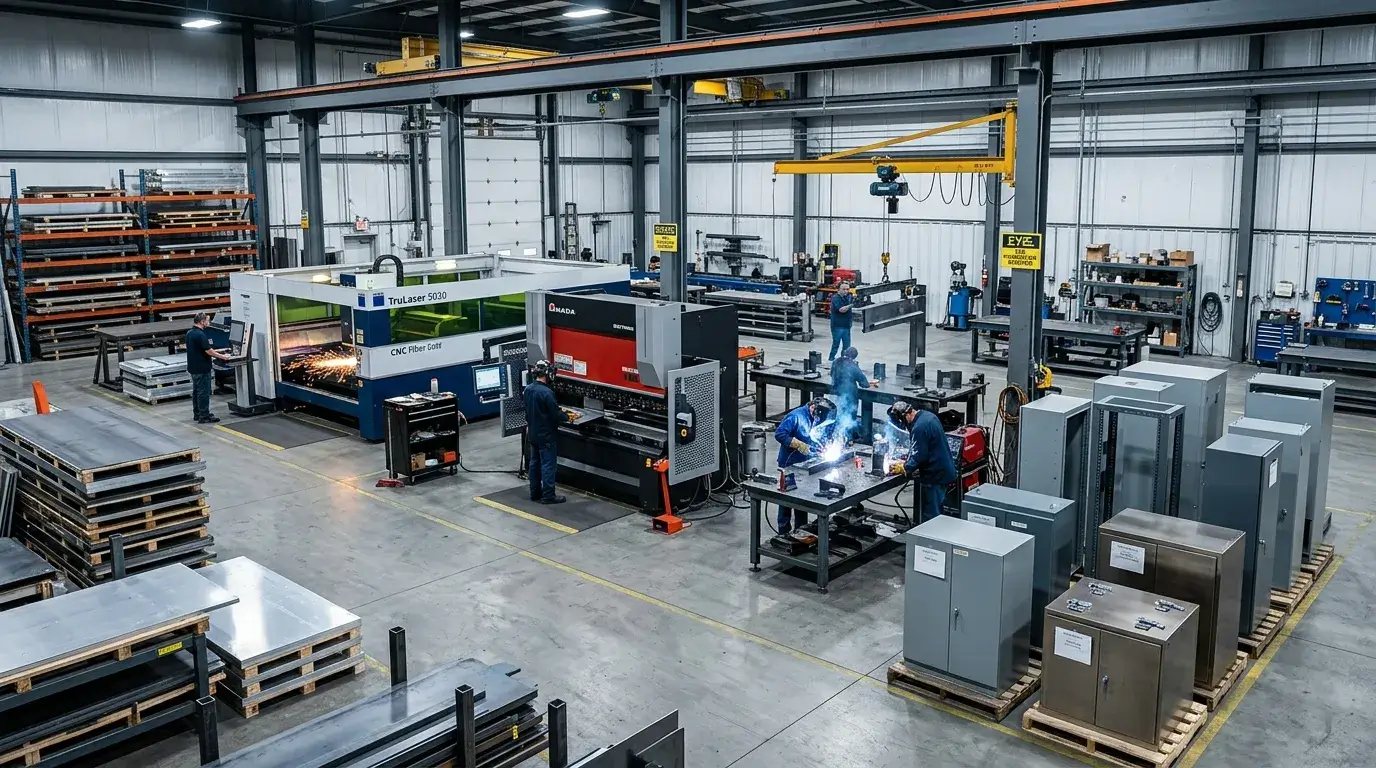
Every metal enclosure, bracket, chassis, and panel you see in a factory, a hospital, or a data center started as a flat sheet of metal. Someone cut it, bent it, welded it, and finished it into the part you are looking at.
That process is sheet metal fabrication.
At ZAK, we do this work every day — turning flat steel, aluminum, and stainless steel sheets into finished components for OEMs and industrial buyers worldwide. In this guide, I will walk through exactly how the process works, what materials are involved, what drives cost, and what to consider when you are sourcing a fabrication project. Everything here reflects what we see and do on our own production floor.
What Exactly Is Sheet Metal Fabrication?
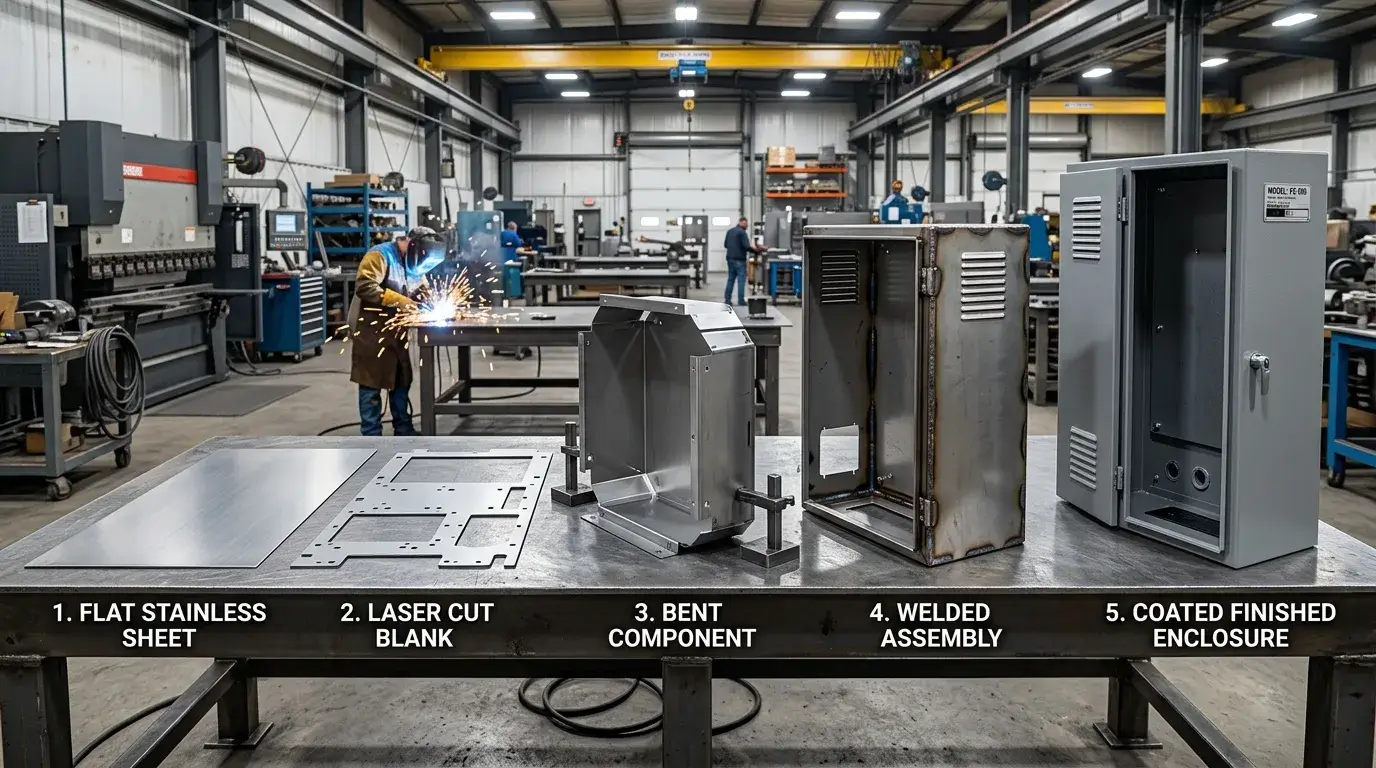
Sheet metal fabrication is the process of turning flat metal sheets into functional parts and structures. We do this through a series of operations: cutting, bending, forming, joining, and finishing.
That sounds simple. But here is what makes it distinct from other metalworking methods:
- Casting pours molten metal into a mold.
- Forging compresses heated metal between dies.
- Extrusion forces metal through a shaped opening.
- Sheet metal fabrication reshapes a flat sheet while keeping its original thickness mostly intact.
The starting material is always a flat metal sheet. We reshape it — we do not melt it, cast it, or extrude it. That is the fundamental difference.
At ZAK, we work with sheets ranging from about 0.5 mm up to 6 mm thick. We use CNC laser cutters to cut profiles, CNC press brakes to bend them, and MIG/TIG welding stations to join components. Then we finish parts with powder coating, plating, or anodizing depending on the application.
Key takeaway: Sheet metal fabrication is a subtractive and formative process. It starts with flat sheet stock and uses cutting, bending, and joining to produce a finished three-dimensional part — without melting the base material.
How Is Sheet Metal Different from Plate Metal?
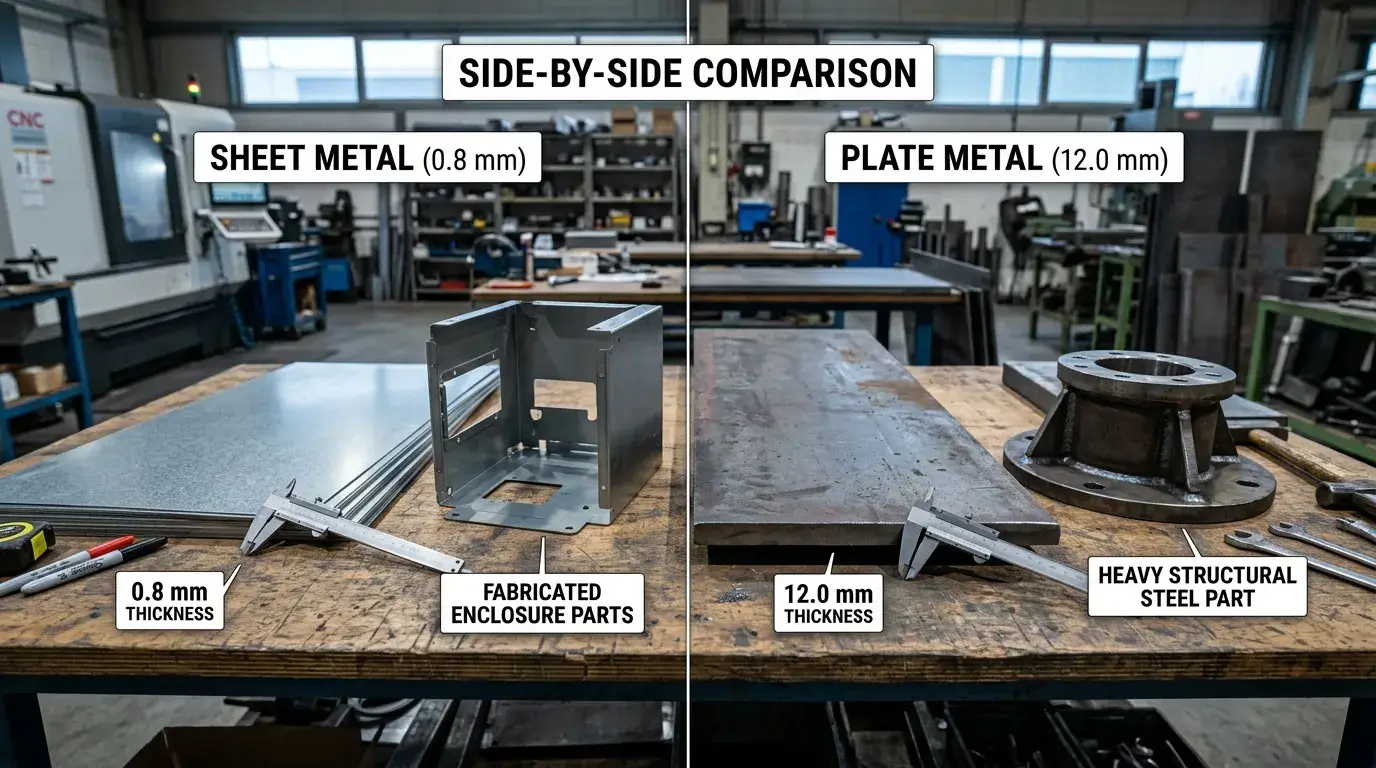
If you are sourcing a fabrication project, this distinction directly affects which suppliers can handle your work.
Sheet metal is generally anything up to about 6 mm (roughly 1/4 inch or 7 gauge) thick. Beyond that thickness, the industry calls it plate metal.
Why does this matter?
| Factor | Sheet Metal | Plate Metal |
|---|---|---|
| Typical thickness | 0.5 mm – 6 mm | 6 mm and above |
| Equipment | Laser cutters, press brakes, turret punches | Heavy press brakes, plasma/oxy-fuel cutters, plate rollers |
| Handling | Often manual (a 4' × 10' piece of 16-gauge steel weighs about 40 kg) | Requires overhead cranes |
| Fabrication shops | Standard sheet metal shops like ZAK | Specialized heavy fabrication shops |
| Typical applications | Enclosures, brackets, panels, housings | Structural beams, ship hulls, heavy machinery frames |
A shop that excels at sheet metal fabrication may not have the equipment or tonnage capacity for plate work. And vice versa. Knowing your material thickness before you start sourcing prevents wasted time on mismatched vendors.
Understanding the Gauge System
Sheet metal thickness is measured in gauge — and the system works backwards from what you would expect. Higher gauge numbers mean thinner metal.
Here is a quick reference:
| Gauge | Steel Thickness (mm) | Steel Thickness (inches) |
|---|---|---|
| 10 | 3.40 | 0.134 |
| 14 | 1.90 | 0.075 |
| 16 | 1.52 | 0.060 |
| 18 | 1.21 | 0.048 |
| 20 | 0.91 | 0.036 |
| 24 | 0.61 | 0.024 |
Important: Gauge values are not universal across materials. A 16-gauge steel sheet is approximately 1.52 mm thick. A 16-gauge aluminum sheet is approximately 1.57 mm thick. The difference is small but matters for precision assemblies where parts must fit together tightly. For a complete gauge-to-thickness conversion chart across steel, aluminum, stainless, and brass, Metal Supermarkets maintains a widely referenced resource.[^1]
At ZAK, we always recommend specifying thickness in millimeters or decimal inches on your engineering drawings. It removes ambiguity and reduces errors.
What Materials Are Used in Sheet Metal Fabrication?
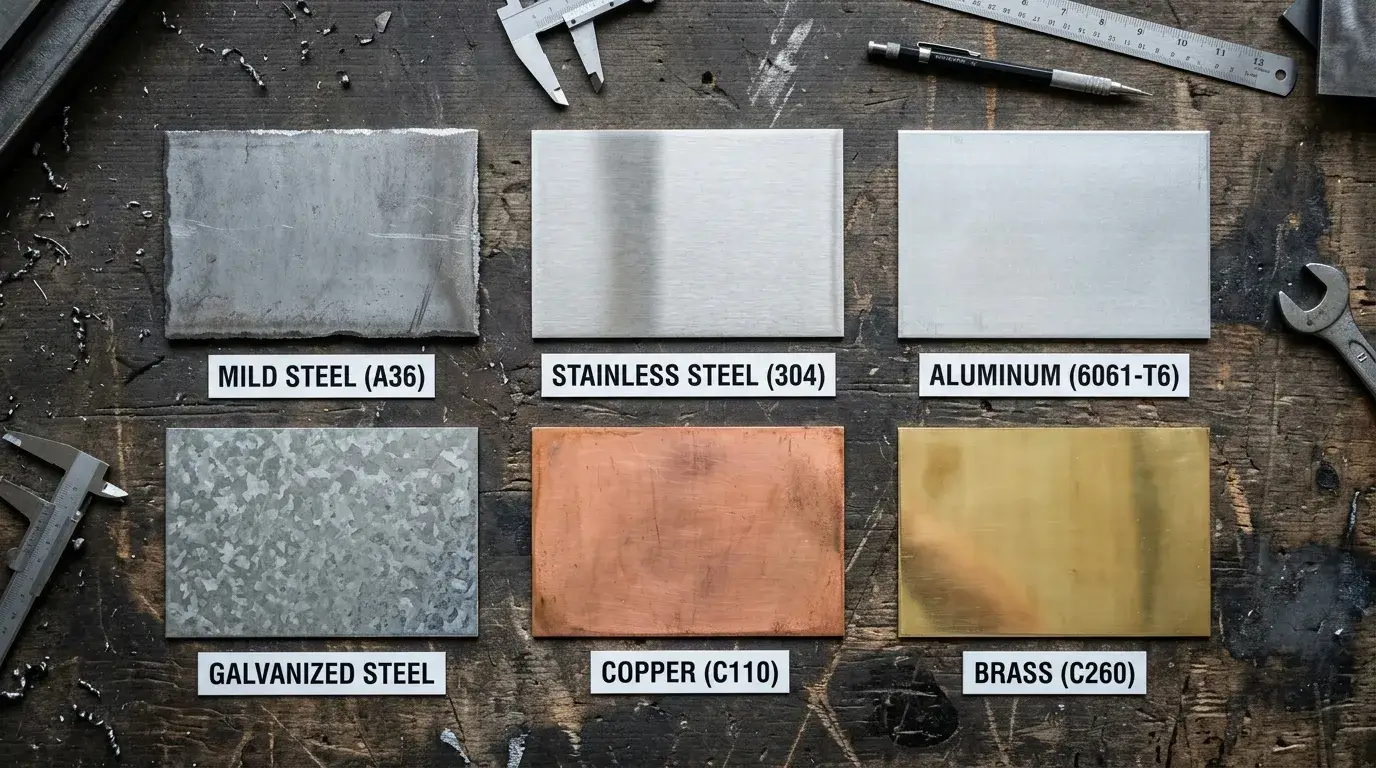
The material you choose affects everything: strength, weight, corrosion resistance, cost, and which fabrication processes work best.
Here are the materials we work with most frequently at ZAK:
Mild / Carbon Steel
This is the workhorse. Carbon steel holds roughly 52% of the global sheet metal market share.[^2] It offers strong mechanical properties, welds easily, and costs less than most alternatives. We use it for industrial enclosures, machine housings, brackets, and structural components. It does need a protective finish (powder coating, painting, or galvanizing) because it rusts without one.
Stainless Steel
Stainless steel contains at least 10.5% chromium, which gives it natural corrosion resistance. We fabricate stainless steel for food processing equipment, medical device housings, and outdoor enclosures that must withstand harsh environments. It costs more than carbon steel and requires more force to cut and bend. But for applications where corrosion resistance is non-negotiable, it is the right choice.
Aluminum
Aluminum weighs about one-third of what steel weighs. It resists corrosion naturally. It conducts heat and electricity well. We use it for electronics enclosures, heat sinks, and lightweight structural parts. It is softer than steel, which means we can achieve tighter bend radii. But it also scratches more easily and requires different welding techniques (typically TIG).
Galvanized Steel
This is carbon steel coated with a zinc layer for corrosion protection. We see it used heavily in HVAC ductwork, outdoor electrical enclosures, and agricultural equipment. One thing to watch: welding galvanized steel produces zinc fumes. Proper ventilation and fume extraction are essential during fabrication.
Copper and Brass
These metals are chosen for electrical conductivity (copper), antimicrobial properties (copper), and decorative appeal (brass). Common applications include electrical busbars, decorative panels, and specialized hardware.
How we help at ZAK: If you are unsure which material is right for your project, send us your design requirements. We will recommend the material that balances performance and cost for your specific application.
What Are the Main Processes in Sheet Metal Fabrication?
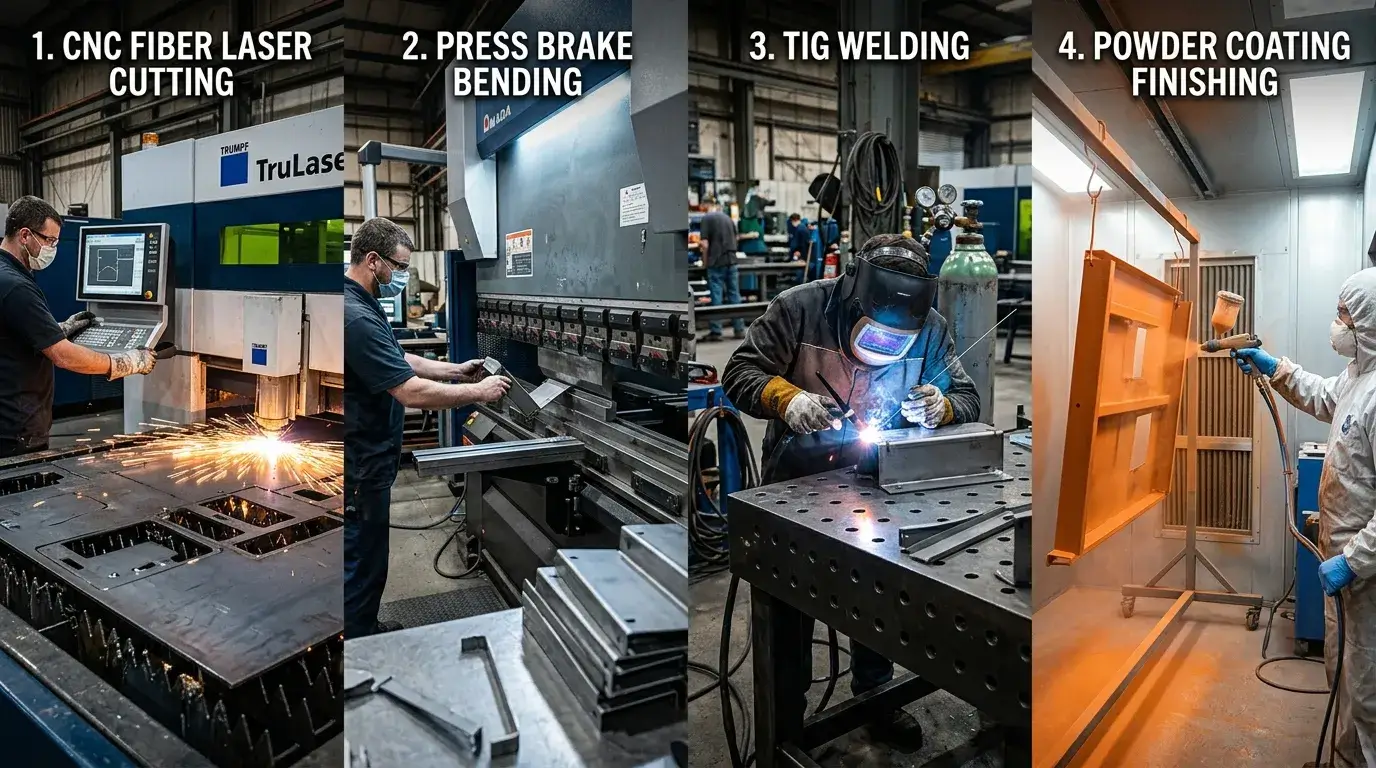
Every sheet metal part goes through some combination of four core process categories: cutting, forming/bending, joining, and finishing. Let me walk through each one with the methods we actually use on our production floor.
Cutting
Cutting is the first step. We take a full-size metal sheet and cut it into the shapes needed for each part.
Laser Cutting — This is our primary cutting method at ZAK. We use CNC fiber laser cutters that follow programmed cut paths directly from CAD files. Fiber lasers cut faster and use less energy than older CO2 systems. They also handle reflective materials like aluminum and brass more effectively. Typical accuracy: ±0.1 mm.
Shearing — This mechanical method uses offset blades to make straight-line cuts. It is fast and cost-effective for simple cuts on thinner materials. No material is lost to a kerf (the gap left by a laser or saw).
Punching / Blanking — CNC turret punch presses use a punch-and-die set to cut holes, slots, and shapes out of the sheet. This is efficient when a part needs many holes or repetitive cutouts.
Plasma Cutting — Uses an ionized gas jet to cut through thicker materials. Less precise than laser cutting, but faster and cheaper on heavy-gauge stock.
Waterjet Cutting — Uses a high-pressure water stream mixed with abrasive particles. The key advantage: zero heat. No thermal distortion, no heat-affected zones. We recommend this for heat-sensitive alloys and applications where material integrity is critical.
Forming and Bending
Once cut, flat blanks are bent and shaped into three-dimensional forms.
CNC Press Brake Bending — This is the most common forming method. A press brake uses a punch and V-die to create bends at specific angles. Our CNC press brakes at ZAK can hold angular accuracy within ±0.5°. Key design considerations include minimum bend radius (generally equal to material thickness for softer metals, and 0.7× thickness for harder materials like stainless steel).[^3]
Roll Forming — This method feeds a metal strip through sequential sets of rollers, progressively shaping it into a consistent cross-sectional profile. It is ideal for producing long, uniform parts like structural channels, roofing panels, and rain gutters at high volume.
Stamping and Deep Drawing — Stamping uses dies under high pressure to form parts rapidly. Deep drawing stretches sheet metal into a cavity to create box-like or cylindrical shapes. Both methods are best suited for high-volume production because the die tooling cost is only justified at scale.
Joining
After cutting and forming, separate pieces are assembled into the final product.
MIG Welding — Fast, versatile, and suited to thicker materials. We use MIG welding for structural joints and high-production assemblies.
TIG Welding — Slower but more precise. Produces cleaner, more controlled welds. We use TIG on thinner materials, visible joints, and aluminum parts where appearance and precision matter.
Spot Welding — Joins overlapping sheets at specific points. Common in automotive and enclosure assembly.
Riveting and Hardware Insertion — Mechanical fastening methods that do not require heat. PEM nuts, standoffs, and blind rivets are pressed or inserted directly into the sheet, providing mounting points for assembly.
Finishing
Finishing protects the part and improves its appearance.
Powder Coating — Our most common finish at ZAK. A dry powder is applied electrostatically and cured under heat. The result is a durable, chip-resistant coating available in hundreds of colors and textures. It outperforms liquid paint in durability.
Anodizing — Specific to aluminum. Creates a hard oxide layer that increases corrosion resistance and can be dyed in colors. Common on electronics enclosures and consumer-facing products.
Plating — Zinc, nickel, or chrome plating deposits a thin metallic layer for corrosion resistance or decorative purposes.
Passivation — A chemical treatment for stainless steel. It removes free iron from the surface and restores the material's natural corrosion resistance after welding or grinding.
What Are the Key Steps from Design to Finished Part?
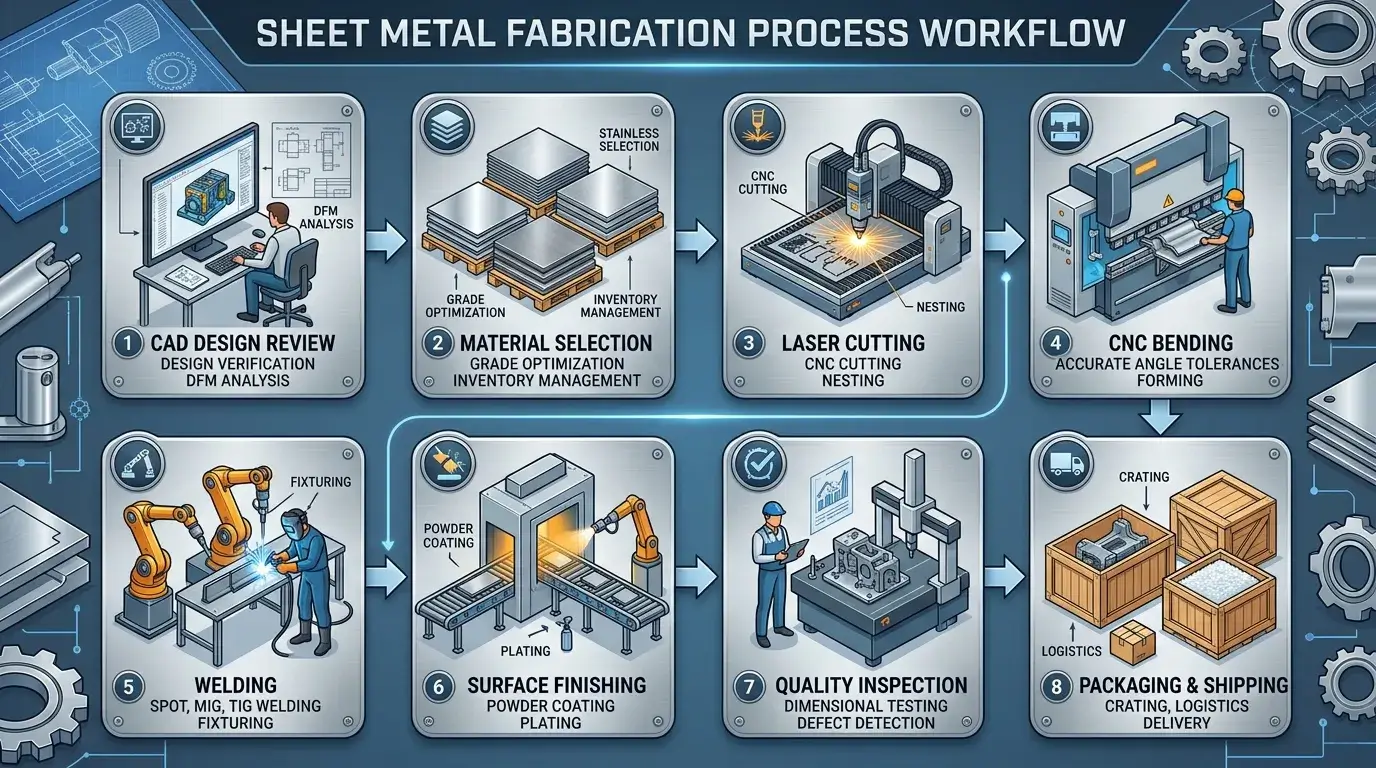
Here is the actual production workflow we follow at ZAK — from the moment we receive your design files to the moment we ship finished parts:
Step 1: Design Review (DFM)
We start by reviewing your CAD files for manufacturability. We check bend radii, hole-to-bend distances, material selection, tolerance requirements, and hardware specifications. If we spot anything that will cause problems on the production floor — a bend too close to a hole, an impractical radius, an unnecessary tight tolerance — we flag it before cutting any metal. A solid Design for Manufacturability (DFM) strategy at this stage prevents expensive rework.[^4]
This step prevents expensive rework. It is the single highest-value step in the entire process.
Step 2: Material Selection and Procurement
Based on your design requirements, we select the right material type, gauge, and temper. We maintain stock of the most common sheet metals (carbon steel, stainless steel, aluminum) in standard gauges. Specialty materials are sourced from certified suppliers with full material traceability.
Step 3: Laser Cutting
Flat sheet stock is loaded onto our CNC fiber laser cutters. The machine follows programmed cut paths generated directly from your CAD files. Nesting software optimizes how parts are arranged on each sheet to minimize material waste.
Step 4: CNC Bending
Cut blanks move to our CNC press brakes. The machine applies controlled force to create each bend at the specified angle and location. Our operators verify the first piece against the engineering drawing before running the batch.
Step 5: Welding and Assembly
Components are welded (MIG or TIG depending on material and requirements), and hardware (PEM nuts, standoffs, studs) is inserted. Welding fixtures ensure consistent positioning across production runs.
Step 6: Grinding and Surface Prep
Weld joints are ground smooth where required. Edges are deburred. Surfaces are cleaned and prepared for finishing.
Step 7: Finishing
Powder coating, plating, anodizing, or painting is applied based on the specification. Our powder coating line includes a chemical pre-treatment stage for proper adhesion and corrosion protection.
Step 8: Quality Inspection
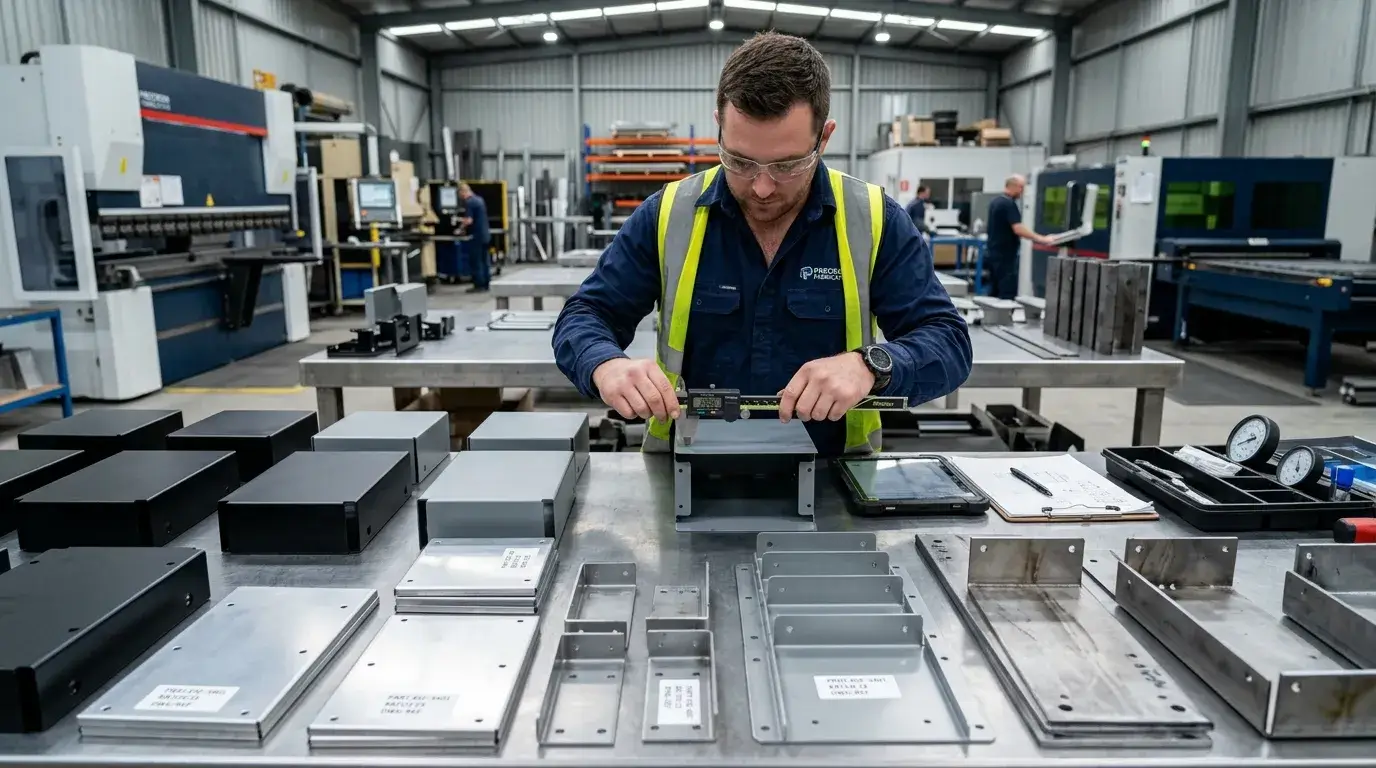
Every batch is inspected against the engineering drawing. We check critical dimensions, finish quality, hardware placement, and cosmetic appearance. Inspection reports and photos are available on request.
Step 9: Packaging and Shipping
Parts are packaged to prevent damage in transit. We ship globally via sea, air, or express freight depending on your timeline.
Which Industries Rely on Sheet Metal Fabrication?
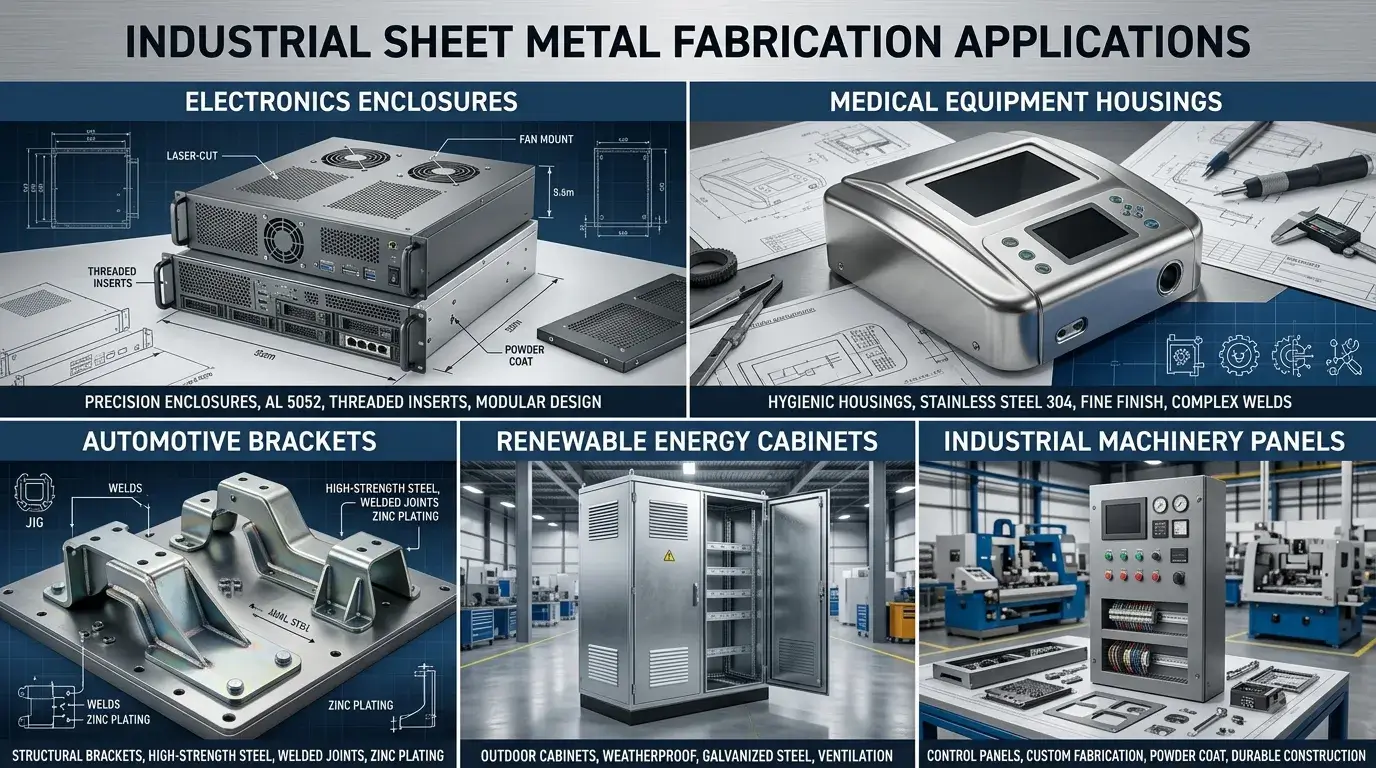
Sheet metal fabrication serves nearly every manufacturing sector. Here is where the demand is concentrated, based on 2025 market data from Fact.MR[^5]:
| Industry | Approximate Share of Sheet Metal Demand | Common Applications |
|---|---|---|
| Automotive & Transportation | ~38% | Body panels, EV battery enclosures, brackets, exhaust systems |
| Construction | ~34% | HVAC ductwork, roofing, wall cladding, structural supports |
| Aerospace & Defense | Significant | Fuselage panels, brackets, equipment enclosures |
| Electronics | Growing rapidly | Server racks, equipment enclosures, heat sinks |
| Medical Devices | Specialized | Equipment housings, surgical carts, sterilization trays |
| Renewable Energy | Fastest-growing segment | Solar panel mounts, wind turbine housings, battery enclosures |
| Consumer Goods | Steady | Appliance housings, HVAC units, vending machines |
Data sources: Fact.MR, Grand View Research, Global Market Insights — 2025 market reports
At ZAK, our largest volume comes from electronics enclosures, industrial equipment housings, and OEM component fabrication. But we serve all of the industries listed above.
What Is the Difference Between Sheet Metal Fabrication and Stamping?
This causes constant confusion. Here is the simple distinction:
Sheet metal fabrication is the broad category. It includes all the processes needed to turn a flat sheet into a finished part: laser cutting, bending, welding, hardware insertion, finishing, and assembly.
Stamping is one specific technique within fabrication. It uses custom dies under high pressure to cut, bend, or form sheet metal in a single operation (or a series of progressive operations).
When to Use Each Approach
| Factor | General Fabrication | Stamping |
|---|---|---|
| Best for | Low-to-medium volume, prototypes, complex assemblies | High volume (thousands+ of identical parts) |
| Tooling cost | No custom tooling needed | Custom dies cost thousands to tens of thousands of dollars |
| Per-part cost | Higher at low volumes, competitive at medium volumes | Very low at high volumes due to speed |
| Flexibility | Design changes are easy and cheap | Design changes require new or modified dies |
| Typical parts | Enclosures, brackets, panels, frames | Automotive panels, appliance housings, metal caps, clips |
Many real-world projects combine both. A stamped bracket might be welded to a laser-cut and bent enclosure, for example.
What Drives the Cost of Sheet Metal Fabrication?
Understanding cost drivers helps you make smarter design and sourcing decisions. While every project is different, here are the factors that move the needle:
Material type and gauge — Stainless steel costs roughly 2–4× more than mild steel per kilogram. Aluminum sits in between. Thicker gauges cost more per sheet and require more powerful equipment.
Part complexity — More bends, tighter tolerances, complex cut profiles, and multiple welded joints all increase cost. Each additional operation adds machine time and labor.
Production volume — Setup costs (CNC programming, fixture setup, first-article inspection) are spread across your total order. A single prototype will cost dramatically more per part than a batch of 1,000.
Tolerances — Standard fabrication tolerances (±0.25 to 0.75 mm) are achievable on most equipment. Precision tolerances (±0.1 mm or tighter) require slower machine speeds, more careful setup, and additional inspection — all of which add cost.
Finishing — A raw part costs less than one requiring powder coating, plating, or anodizing. Each finishing step adds both cost and lead time.
Custom tooling — If your design requires stamping dies or specialized bending tooling, the upfront investment can be significant. But it is amortized across the production run.
Cost-saving tip from our production floor: The single biggest cost driver we see is over-tolerancing. If a dimension does not need ±0.1 mm, do not specify it. Use standard tolerances where function allows. We can help you identify which dimensions are truly critical during DFM review.
How Is Technology Changing Sheet Metal Fabrication?
The industry is evolving fast. Here are the shifts we see and invest in at ZAK:
CNC and Automation
Over 70% of new product developments in sheet metal focus on automation and robotics.[^6] CNC-controlled laser cutting and bending deliver tighter tolerances and higher repeatability than manual methods. Robotic welding handles repetitive joints with perfect consistency.
AI-Driven Nesting Software
Modern nesting software uses algorithms to optimize how parts are arranged on each metal sheet. Better nesting means less scrap. At ZAK, our nesting optimization typically achieves 85%+ material utilization.
Digital Workflow Integration
CAD files flow directly to CNC machines without manual re-entry. This eliminates transcription errors and shortens lead times. In construction, Building Information Modeling (BIM) is now being integrated with fabrication equipment — pulling component specifications directly from the building's digital model.
Sustainability
Over 60% of manufacturers are investing in carbon-neutral production. Metals are inherently recyclable (steel is the most recycled material in the world). Advanced nesting reduces waste. Energy-efficient fiber lasers consume less power than older systems. These are not marketing claims — they are measurable operational improvements.
How to Choose the Right Sheet Metal Fabricator
If you are evaluating fabrication partners, here is what to look for:
Industry-specific experience — Ask for examples of projects similar to yours. An aerospace enclosure requires different capabilities than a retail display unit.
Certifications — ISO 9001 at minimum.[^7] AS9100 for aerospace. ITAR for defense. These certifications indicate documented processes and accountability.
Equipment match — Confirm the shop has the laser cutting capacity, press brake tonnage, welding capability, and finishing options your project requires.
DFM support — A good fabricator will review your design and suggest cost-saving improvements before production starts. This is not a nice-to-have — it is a sign of a capable partner.
Prototype-to-production capability — If your project starts with prototypes and scales up, working with one fabricator for both phases prevents knowledge loss between vendors.
Transparency — Ask how the quote was built. The lowest price often means missed requirements. A clear, itemized quote builds trust.
Frequently Asked Questions
Is sheet metal fabrication the same as welding?
No. Welding is one joining technique used within fabrication. But fabrication also includes cutting, bending, hardware insertion, finishing, and assembly. A complete fabrication project might use zero welding (riveted or fastened assemblies) or extensive welding, depending on the design.
What is precision sheet metal fabrication?
It refers to the same processes but executed to tighter tolerances — typically ±0.1 mm or better. Precision fabrication requires more advanced equipment, stricter process control, and more thorough inspection. It is common in aerospace, medical, and electronics applications.
What is the K-factor in sheet metal bending?
The K-factor determines where the neutral axis sits during a bend.[^8] It directly affects flat pattern dimensions — meaning the size of the flat blank needed to produce the bent part. Its value ranges from 0 to 0.5 and varies based on material, thickness, bend radius, and bending method. Getting it wrong means the finished part will not match the intended dimensions. At ZAK, we calibrate K-factors empirically for each material and machine combination.
Can sheet metal fabrication be used for prototypes?
Absolutely. One of the biggest advantages of fabrication (versus stamping or casting) is that it requires no custom tooling. We can laser-cut and bend a single prototype part using the same CNC equipment we use for production runs. This makes it ideal for testing designs before committing to volume.
What tolerances can sheet metal fabrication achieve?
Standard tolerances range from ±0.25 to ±0.75 mm depending on the process. Laser cutting typically achieves ±0.1 mm. CNC bending holds ±0.5° on angle. Precision fabrication with careful process control can achieve ±0.05 mm on critical dimensions. For specific tolerance and thickness guidelines by material, Xometry maintains a useful engineering reference.[^9]
Conclusion
Sheet metal fabrication is one of the most versatile and widely used manufacturing methods in the world. The global sheet metal market is valued at approximately $430 billion in 2025, serving virtually every industrial sector from automotive to renewable energy.[^10]
But the real value of understanding this process is practical. When you know how cutting, bending, welding, and finishing work — and how material choice, gauge, tolerances, and volume affect cost — you make better sourcing decisions. You avoid over-engineering. You find the right fabrication partner faster.
At ZAK, we have built our capabilities around exactly this kind of work: precision sheet metal fabrication for engineers and buyers who need reliable parts, delivered on time, at competitive cost.
If you have a project that needs sheet metal fabrication — whether it is a first prototype or a recurring production order — request a quote from ZAK and let us show you what we can do.
Published by ZAK (zakfab.com) — Precision Sheet Metal Fabrication | Laser Cutting | CNC Bending | Welding | Powder Coating | Global Shipping
[^1]: Metal Supermarkets — Sheet Metal Gauge Chart. A comprehensive reference covering gauge-to-thickness conversions for mild steel, stainless steel, aluminum, galvanized steel, brass, and copper. Useful for verifying callouts on engineering drawings.
[^2]: Fact.MR — Sheet Metal Market Global Analysis Report, 2035. Market research report valuing the global sheet metal market at USD 430 billion in 2025, with carbon steel holding 52% market share and automotive/transport accounting for 38% of demand.
[^3]: Five Flute — Sheet Metal DFM: Design Guidelines for Formed and Punched Parts. An engineering-focused guide covering minimum bend radius rules, hole placement, and flat pattern considerations for sheet metal design.
[^4]: DFMA — What Is Design for Manufacturing (DFM)? A primer on DFM principles, cost-driver analysis, and process selection that helps engineers reduce production costs and lead times during the design phase.
[^5]: Fact.MR — Sheet Metal Market, 2025. Industry demand breakdown by sector, showing automotive & transport at 38% share and construction at 34%+ of total sheet metal consumption.
[^6]: Technavio — Sheet Metal Market Growth Analysis, 2025–2029. Market research noting that over 70% of new product developments in the sheet metal industry focus on automation and robotics.
[^7]: ISO — ISO 9001:2015 Quality Management Systems. The official ISO page for the globally recognized quality management standard, used by over one million certified organizations in 189 countries.
[^8]: Protolabs Network (Hubs) — Sheet Metal Fabrication Design Guide. A detailed technical reference covering K-factor, bend allowance, laser cutting best practices, and design tolerances for sheet metal parts.
[^9]: Xometry Pro — Sheet Metal Thickness Standards & Gauge Charts. Engineering reference covering gauge-to-thickness conversions, tolerance standards, and practical design considerations for sheet metal fabrication.
[^10]: Fact.MR — Sheet Metal Market Value (2025): USD 430.0 Billion. Projected to reach USD 560 billion by 2035 at 2.7% CAGR, driven by infrastructure development, automotive production, and manufacturing demand.